The Bridge That Must Grow
What it would take for a computer to become more than a tool
The corpus callosum looks like a cable. It is easy to forget that it was never installed.
In The Fabric Between Flashes, I wrote about the surprising sparseness of the bridge between the human hemispheres. A recent model put the average corpus callosum near 260 million axons. Combined with a separate estimate of 16.34 billion cortical neurons, that gives a heuristic scale ratio of about 1.6 fibers for every hundred neurons—not a wiring probability. This did not show that consciousness needs a particular number of wires. It suggested a more modest possibility: a selective set of long-range paths can matter out of proportion to its size when signals cross, return, and alter the activity that sent them.[1]
That finding invites a larger dream. If two vast neural fields can belong to one life across a selective bridge, perhaps a human mind could grow another shore. Not merely a computer we consult, or a memory store we search, but a digital region whose perceptions arrive as part of what we perceive; whose inferences enter thought before they have to be read; whose history is inherited by the next human moment as naturally as the last.
There is no evidence that any present interface can do this. Brain–computer interfaces can restore movement, communication, and fragments of sensation. Tools can become automatic; users can experience degrees of ownership and agency over prostheses. None of those results shows that a conscious subject has expanded into a machine.
But they let us ask a better engineering question. If the aim were not mind reading, device control, or uploading a copy, what kind of joint would give expansion its best chance?
The answer, I suspect, would not be a thicker cable. It would be a bridge with something like a childhood.
The bridge had a childhood
The two hemispheres were never independent machines waiting to be connected. Across mammalian studies, many early callosal projections are exuberant and later stabilized or eliminated, with sensory and neural activity influencing their refinement. In humans, callosal formation begins prenatally, substantial refinement follows, and myelination and functional maturation continue through childhood and beyond. The mature bridge is sparse partly because human development has spent years refining which threads deserve to remain.[2]
The hemispheres also share more than the callosum. They grew inside one organism, under common metabolic and neuromodulatory conditions. They learned from the same eyes, limbs, rooms, dangers, and people. They communicate through other cortical and subcortical routes. Before either side could tell a story about itself, both were already being corrected by one body.
A digital graft would arrive as a stranger.
This is the hidden problem in treating the callosal count as an interface specification. The same number of channels can carry a native language, an unknown cipher, or noise. Bandwidth measures how much can cross. It does not determine whether what crosses can enter perception, revise memory, guide action, or return in a form the sender can use.
The relevant property of a bridge is therefore not resemblance alone and not capacity alone. It is mutual learnability: can activity on each side repeatedly acquire consequences on the other until the traffic stops needing to be interpreted as traffic?
That threshold is demanding even for modest sensory additions. In one study, a wearable device continuously translated magnetic north into sound. After five days, participants could use it, but their responses did not reach the level of automaticity the researchers treated as a prerequisite for a genuinely new “feel of north.” A new skill had appeared. A new percept had not been demonstrated.[3]
Learning to read a signal is not yet learning to see through it.
Four ways a machine can be inside us
The word expansion hides several different achievements.
A computer can be inside a person’s reach. I intend a movement and a cursor moves. It can be inside a person’s skill: after practice, control becomes fast and largely automatic. It can become embodied: action begins to anticipate the device, body-related behavior or neural representation changes around it, and the person may—separately—report agency over it or ownership of it. And it might, in the strongest and least understood sense, enter the person’s field of experience: some of the machine’s activity would not merely cause a report but become part of what the expanded subject lives through.
The first three can be investigated from converging behavior, physiology, and report. The fourth cannot currently be isolated by an agreed test. We still lack a settled account of which mechanisms are necessary for human consciousness, much less a meter for deciding whether one point of view has crossed a manufactured boundary.[4]
This does not make the idea meaningless. It gives it an evidence ladder. An interface meant for lived expansion should first demonstrate stable bidirectional control, low-effort use, automatic perceptual effects, reciprocal adaptation, and separately measured changes in agency, ownership, sensorimotor prediction, body representation, and access to shared memory. Each result would make the functional case stronger. None should be renamed proof of phenomenal fusion.
The distinction matters because a device can become indispensable without its internal states becoming constituents of my cognition or experience. I may store half my life on a phone and still experience the phone as an object I must consult. The missing step is not storage. It is the difference between the answer is available over there and I remember.
The direct connection is not the mistake
It is tempting to blame that distance on the opposition between wet biology and digital silicon. Yet the history of neural prostheses warns against material purism.
A modern cochlear implant uses microphones and digital signal processing to turn sound into electrical stimulation of the auditory nerve. The resulting input is severely compressed and unlike ordinary cochlear transduction, but experience and neural plasticity can make it usable for speech. The machine does not have to become biological all the way down for its signal to enter hearing.[5]
Bidirectional cortical interfaces make the point more directly. In a 2021 study, sensors on a robotic hand drove stimulation in the somatosensory cortex of a participant with tetraplegia. The evoked touch was felt as originating in his own palm and fingers. Adding that afferent channel cut the median time for a set of object-manipulation trials from 20.9 to 10.2 seconds.[6] A digital loop reached into both action and sensation without sharing the brain’s material.
Nor must every mapping begin as a perfect imitation of a natural one. Fixed decoders supported increasingly stable neuroprosthetic control in two macaques; in one of them, an initially non-biomimetic shuffled decoder supported accurate control after several days, and a stable cortical map emerged. In a human participant using a chronic electrocorticography interface, carrying decoder weights across days helped stabilize control and enabled “plug-and-play” use; reinitializing the decoder each day forced variable relearning.[7][8]
These experiments point away from a simple analog–digital barrier. The nervous system can learn a foreign transformation when the mapping is stable, consequences are timely, and feedback closes the loop. In some intraneural prosthesis studies, biomimetic frequency encoding produced more natural sensations, while hybrid biomimetic and amplitude strategies improved functional performance.[8] Physical similarity is not a password that automatically admits a device into the self.
The naive bridge is naive for another reason. It imagines two finished spaces exchanging messages. A viable bridge would have to change its code as the brain changed, while remaining stable enough for the brain to learn it. It would have to translate in both directions without becoming the sole author of either. It would need to grow.
How unlike materials actually meet
Engineers join dissimilar metals all the time. What they distrust is an untreated mismatch.
Galvanic corrosion is real, but it does not occur merely because two metals are different. It requires an electrochemical potential difference, an electron-conducting path, and an electrolyte. Particular material pairs can also be difficult to join because their melting ranges or thermal expansion differ, because brittle compounds form at the boundary, or because residual stress concentrates where one set of properties abruptly becomes another.[9][10]
One family of solutions uses a purpose-built transition joint, often made by a solid-state process, so each component can be joined to a compatible end; some designs add an interlayer. This relocates or divides the difficult boundary and lets each field joint use a compatible process. A functionally graded region instead changes its composition or properties across a distance, spreading an abrupt property change and some of its stresses. Neither approach abolishes failure.[10]
That is a better metaphor for a human–machine interface than corrosion alone. A biological and a digital cognitive space need not poison each other because they are unlike. They can still fail at the seam: one may update much faster, one may dominate the shared policy, one may receive a signal it cannot interpret, or both may continually adapt until neither can learn a stable relationship.
There is already a small warning in motor augmentation. After five days of training with a robotic Third Thumb, participants gained dexterity and coordination and reported a stronger sense of embodiment. During Third Thumb use, the biological fingers’ natural kinematic synergies weakened, and imaging showed a mild short-term reduction in how distinctly the augmented hand’s fingers were represented; limited follow-up suggests that change may have partly diminished. Whether that reorganization was adaptive, maladaptive, or lasting remains unresolved. In a separate 2026 experiment with a co-adaptive myoelectric cursor, a fast-learning decoder produced worse performance and disrupted the human–decoder relationship compared with a slower one.[11] Neither result is cognitive corrosion, and neither is evidence of two minds competing. Together, the studies show that augmentation and co-adaptation have consequences and timescales: an added capacity can coincide with reorganization of existing control, while a machine that adapts too quickly can prevent a shared protocol from settling.
Greater machine intelligence would not collapse these layers into one clock. It might accelerate design and optimization while the joint still had to survive tissue response, human learning, manufacturing, consent, regulation, and ordinary use. The transition would be paced by whichever layer could not safely be skipped.
A good joint must therefore distribute not only signals but adaptation.
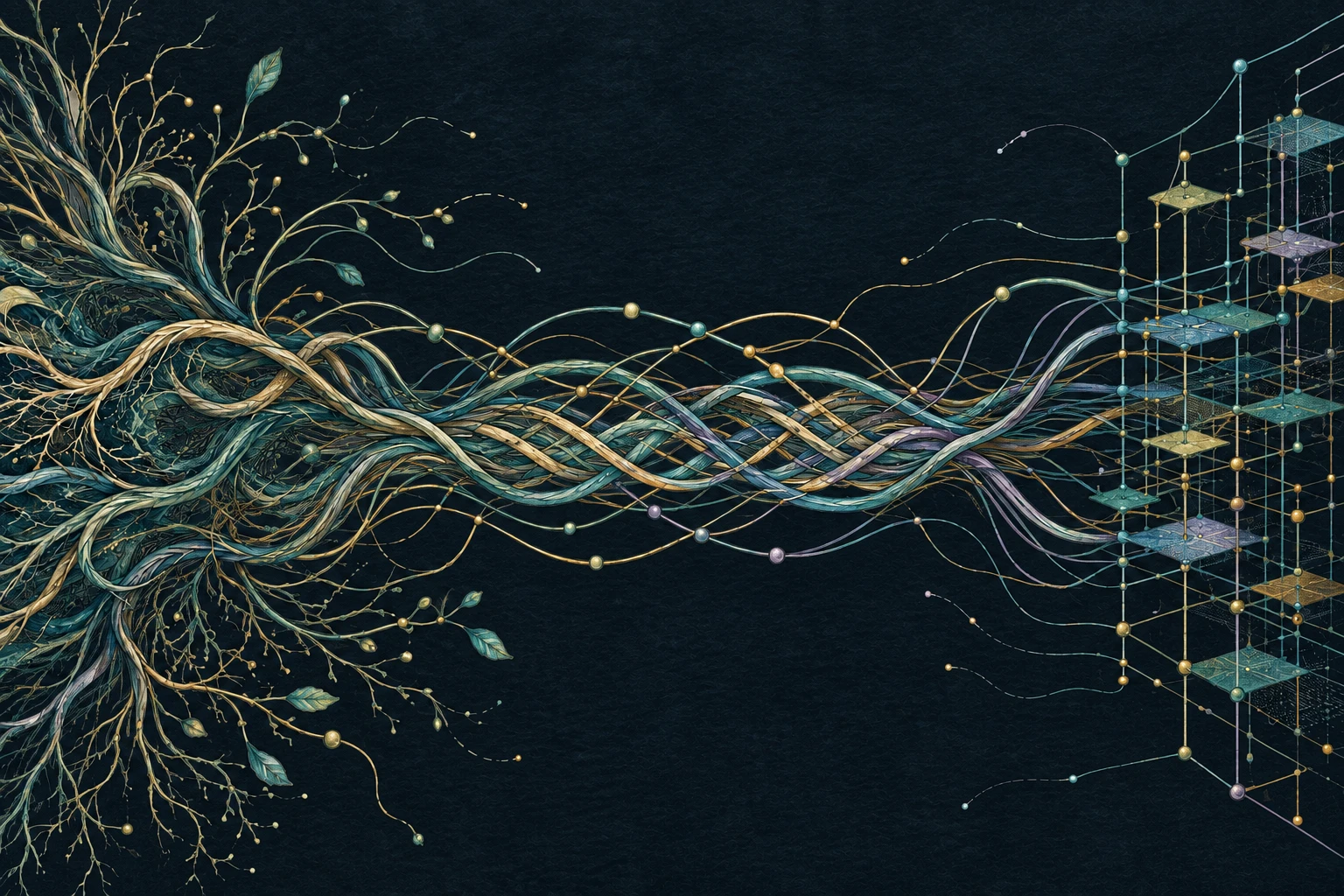

A learned transition joint, imagined as a weave. This is a conceptual analogy, not a device design or evidence of expanded consciousness.
Five dimensions of the joint
The transition I imagine is not one chip. Materials, timing, and representation may be graded across the stack; causal reciprocity and self-rule must govern it end to end.
Material
At the wet edge, materials matter literally. An implanted interface must be biocompatible, selective, mechanically compliant, and stable. A rigid electrode against soft nervous tissue can provoke stress, movement, inflammation, and encapsulation; making contacts smaller can improve selectivity while reducing robustness and tightening limits on maximum injectable charge per contact. This is not a metaphorical mismatch. It is the physical joint.[12]
Organic mixed ionic–electronic conductors are intriguing here because they can couple the ionic signals used by biology to electronic conduction. Organic electrochemical transistors can operate in aqueous environments at low voltage, amplify biological signals, and be made soft and conformable. Researchers have built printed organic electrochemical neurons and synapses with ion-mediated spiking and short- and long-term conductance changes used as analogues of plasticity. The demonstrations remain early and do not amount to a chronic bidirectional human neural interface.[13][14]
If we want a literal material interlayer, this family is closer to the image than a data-center accelerator. Ionic motion modulates electronic current inside the device. The two regimes meet in the act of transduction.
Time
The next layer would convert many noisy, drifting measurements into events the nervous system can learn, and convert neural activity into machine state without pretending that every spike has a fixed dictionary meaning.
Here neuromorphic and mixed-signal circuits may help. They can preserve event timing, local state, and parallelism close to the tissue instead of repeatedly shipping raw samples to a distant processor. But matching the brain does not mean copying a cartoon neuron. The interface should reproduce the causal regularities the brain needs: a given change should arrive within a learnable delay, related changes should stay related, and the same action should not acquire a new alphabet overnight.
In these motor-interface tasks, a nervous system could consolidate a foreign stable map. Replace the map as it begins to settle, and learning can be disrupted.
Uncertainty
A useful bridge should not translate a living population into one brittle command. It should carry uncertainty.
Recording conditions and decoder performance can change within and across sessions as neural activity and electrode–tissue coupling vary. On the return path, percept intensity, quality, and discriminability depend on the electrode and stimulation parameters, although an evoked percept’s projected location can sometimes remain stable for years.[8][12] A co-adaptive model should therefore maintain distributions over possible meanings, ask for more evidence when confidence is low, and learn from the person’s corrections. It should let ambiguous states remain ambiguous rather than forcing a false certainty into the nervous system.
This is where thermodynamic or other probabilistic hardware could be tested—not as consciousness material, but as a physical sampler for uncertain latent states. Whether it would be more efficient than digital probabilistic computation on the relevant neural workload remains unmeasured.
The causal loop
The bridge must close more than a communications loop. It must close a loop of consequences.
If a digital state only appears when queried, it remains a consulted tool. For incorporation, some machine states would need to persist, predict, and change what the person perceives or does; the resulting action would change the world; new sensation would revise both the neural and digital state. The bridge would need many such round trips at behaviorally relevant timescales, with neither side reduced to a passive display.
This is the functional heart of expansion: not that every process becomes conscious, but that the external process joins the causal history from which conscious contents, memories, and actions are drawn.
The control plane of self-rule
This control plane is easy to omit because it is not a signal-processing problem. An interface that can write into perception, affect, or action must preserve the person’s ability to refuse, disconnect, inspect changes, and return the device to a tested safe configuration. Biological learning cannot necessarily be rolled back with the software. Updates cannot silently rewrite the mapping by which the user recognizes intention as their own. Private neural data cannot become the price of remaining integrated with one’s memory or senses.
Autonomy, mental privacy, reversibility, and security are not guardrails placed around the real bridge. They are part of whether the bridge continues to belong to the person at all. International neurotechnology frameworks now treat precisely these questions—identity, freedom of thought, privacy, safety, and agency—as central rather than incidental.[15]
Without self-rule, the machine would not expand a subject. It would acquire leverage over one.
Where Extropic belongs
The company is called Extropic, not Ectropic. Its work offers an engineering rhyme for the middle of this architecture, but not yet the joint itself.
Extropic has demonstrated programmable stochastic primitives in subthreshold CMOS: on X0, separate binary, categorical, Gaussian, and Gaussian-mixture samplers are controlled and routed by a conventional CPU and FPGA, and in an Extropic-authored preprint one calibrated p-bit supplied the randomness for 20,000 samples from an eight-site Ising target—a host-managed, toy-scale demonstration, not a native Ising network on X0. In summer 2026 the company said it had manufactured dozens of XTR-0 systems and taped out a much larger Z1 chip; the Z1 figures and 2027 systems remain company-announced targets, not independent benchmarks.[16] The present p-bit’s sampled state is binary even though its voltages, noise, and bias controls are continuous, and a separate 2026 preprint proposing a continuous-variable thermodynamic stack reports preliminary relaxation measurements on one of three uncoupled superconducting double-well devices, with binary readout—a building-block experiment, not a biological interface.[17]
Still, the intuition contains something valuable. A local stochastic substrate could maintain several live interpretations of an uncertain neural state, update them rapidly, and pass a structured distribution to conventional digital memory and reasoning; if a future end-to-end system proved more energy-efficient on the relevant neural workload, that could ease the power and tissue-heating constraints of continuous implanted use.
What it would not supply by itself is meaning. Thermal noise is not neural language. An energy landscape is not a body. Continuous motion through a state space is not evidence of lived duration. If an ordinary digital processor and a thermodynamic sampler produced exactly the same timestamped stimulation and future updates, the nervous system would receive the same causal history. Without some additional physical path into tissue, there is no established empirical basis for expecting the hidden substrate to change incorporation.
The useful comparison therefore needs three controls: the same probabilistic model on identical recorded streams, to compare calibration, latency, energy, and heat; counterbalanced live blocks in which each backend draws its own samples under a fixed codec, calibration, and timing envelope; and blinded exact replay of one output trace while nominally swapping hardware, where any reproducible effect would expose an uncontrolled cue or physical path. Thermodynamic hardware earns an engineering role if it improves the first two comparisons—not a privileged claim to consciousness in the third.
The best part of the proposal is not thermal. It is transitional.
How a bridge could learn to belong
The first experiments should not attempt to merge a healthy person with a powerful autonomous model. They should build the evidence ladder one rung at a time, using reversible, low-stakes mappings and beginning noninvasively. Any invasive phase would require a favorable device-specific risk–benefit assessment, independent ethics and regulatory review, and informed consent; a diagnosis alone would not justify implantation. Where feasible, such work should begin with participants already implanted for an independently justified indication.
The ladder climbs in four rungs. Begin with one new variable—magnetic north, distance behind the body, the force at an insensate fingertip—delivered through a stable channel, and test whether it becomes fast, automatic, resistant to distraction, and integrated with movement, as wearable north-belt studies already do noninvasively while stopping far short of phenomenal proof.[3] Then close the outward path and let the participant act on the variable without translating it into words, checking whether performance survives occluded vision, whether transfer appears in an untrained task, and whether confidence tracks hidden changes in reliability. Then let both sides adapt in separated phases, holding the machine mapping fixed while the person learns and gating machine updates while monitoring drift, because biological plasticity cannot be switched off and a bridge that improves only while both sides chase each other may be unstable. Only after that should the digital side acquire persistent memory and reasoning, where the question is not whether the participant can retrieve a file but whether the digital state’s absence produces a specific, measurable loss and whether what happens through it enters autobiographical memory.
Even success at every stage would leave the deepest question open. Automatic access, agency, ownership, and shared memory could all grow while the computer remained an unconscious component of one embodied person’s cognitive machinery. Or those functions could be part of how a point of view extends. We do not yet have the theory that would decide between them.
The further shore
An expansion interface would probably arrive without a moment of migration. No self would leap from carbon into silicon. The first genuine change might be smaller and stranger: a signal that stops feeling like a signal; a digital uncertainty that bends attention before it becomes a sentence; a memory reached without the experience of searching somewhere else.
Then perhaps a new reflex. A new sense. A new region of practical thought whose removal feels less like losing a tool than losing access to a familiar part of the world.
The corpus callosum is sparse, but its threads were selected inside a shared life. That is the more important inheritance. A bridge capable of carrying lived experience may need compatible materials at the tissue, probabilistic and temporal translation in the middle, digital depth beyond it, and reciprocal plasticity throughout. Above all, it would need a history in which both sides are repeatedly changed by the same consequences.
We should not ask one material to solve what only development can solve.
The bridge between a person and a computer may never become another shore of consciousness. But if it can, I doubt we will build it by forcing two completed minds together. We will build a place between them where signals can acquire meaning, where agency remains answerable to the person, and where something new is given time to grow up belonging to both.
References and further reading
1. Burke Q. Rosen and Eric Halgren, “An Estimation of the Absolute Number of Axons Indicates That Human Cortical Areas Are Sparsely Connected”, PLOS Biology 20, 2022; Frederico A. C. Azevedo et al., “Equal Numbers of Neuronal and Nonneuronal Cells Make the Human Brain an Isometrically Scaled-Up Primate Brain”, Journal of Comparative Neurology 513, 2009.
2. Noelia S. De León Reyes, Lorena Bragg-Gonzalo, and Marta Nieto, “Development and Plasticity of the Corpus Callosum”, Development 147, 2020.
3. Christoph Witzel et al., “Can Perception Be Extended to a ‘Feel of North’? Tests of Automaticity with the NaviEar”, Adaptive Behavior 31, 2023; Kai Kaspar et al., “The Experience of New Sensorimotor Contingencies by Sensory Augmentation”, Consciousness and Cognition 28, 2014; Vincent Schmidt et al., “Improved Spatial Knowledge Acquisition through Sensory Augmentation”, Brain Sciences 13, 2023.
4. Anil K. Seth and Tim Bayne, “Theories of Consciousness”, Nature Reviews Neuroscience 23, 2022; Cogitate Consortium et al., “Adversarial Testing of Global Neuronal Workspace and Integrated Information Theories of Consciousness”, Nature 642, 2025.
5. James B. Fallon, Dexter R. F. Irvine, and Robert K. Shepherd, “Neural Prostheses and Brain Plasticity”, Journal of Neural Engineering 6, 2009; see also Robert P. Carlyon and Tobias Goehring, “Cochlear Implant Research and Development in the Twenty-first Century: A Critical Update”, Journal of the Association for Research in Otolaryngology 22, 2021.
6. Sharlene N. Flesher et al., “A Brain–Computer Interface That Evokes Tactile Sensations Improves Robotic Arm Control”, Science 372, 2021.
7. Karunesh Ganguly and José M. Carmena, “Emergence of a Stable Cortical Map for Neuroprosthetic Control”, PLOS Biology 7, 2009.
8. Daniel B. Silversmith et al., “Plug-and-Play Control of a Brain–Computer Interface through Neural Map Stabilization”, Nature Biotechnology 39, 2021; David Sussillo et al., “Making Brain–Machine Interfaces Robust to Future Neural Variability”, Nature Communications 7, 2016; Giacomo Valle et al., “Biomimetic Intraneural Sensory Feedback Enhances Sensation Naturalness, Tactile Sensitivity, and Manual Dexterity in a Bidirectional Prosthesis”, Neuron 100, 2018.
9. NASA Kennedy Space Center, “Forms of Corrosion: Galvanic Corrosion”, updated 2023; see also NASA-STD-6012A, §4.9.4, 2022.
10. Kristian Martinsen, S. Jack Hu, and Bruce E. Carlson, “Joining of Dissimilar Materials”, CIRP Annals 64, 2015; Himanshu Lalvani et al., “A Solid-State Joining Approach to Manufacture of Transition Joints for High Integrity Applications”, Journal of Manufacturing Processes 73, 2022; Ashley Reichardt et al., “Advances in Additive Manufacturing of Metal-Based Functionally Graded Materials”, International Materials Reviews 66, 2021.
11. Paulina Kieliba et al., “Robotic Hand Augmentation Drives Changes in Neural Body Representation”, Science Robotics 6, 2021; Maneeshika M. Madduri et al., “Computational Framework to Predict and Shape Human–Machine Interactions in Closed-Loop, Co-Adaptive Neural Interfaces”, Nature Machine Intelligence 8, 2026.
12. Elisa Donati and Giacomo Valle, “Neuromorphic Hardware for Somatosensory Neuroprostheses”, Nature Communications 15, 2024; Charles M. Greenspon et al., “Evoking Stable and Precise Tactile Sensations via Multi-Electrode Intracortical Microstimulation of the Somatosensory Cortex”, Nature Biomedical Engineering 9, 2025.
13. Abdulelah Saleh et al., “Bioelectronic Interfaces of Organic Electrochemical Transistors”, Nature Reviews Bioengineering 2, 2024.
14. Padinhare Cholakkal Harikesh et al., “Organic Electrochemical Neurons and Synapses with Ion-Mediated Spiking”, Nature Communications 13, 2022.
15. UNESCO, “Recommendation on the Ethics of Neurotechnology”, adopted November 2025; OECD, “Recommendation of the Council on Responsible Innovation in Neurotechnology”, 2019.
16. Nahuel Freitas et al., “Taming Nonequilibrium Thermal Fluctuations in Subthreshold CMOS Circuits”, Physical Review Applied 25, 2026; Guillaume Verdon et al., “A Framework for Stochastic Differentiable Programming”, arXiv preprint, August 2026; Extropic, “From One to One Billion: Torx, Thermalizers, and Z1”, company announcement, August 2026; see also “TSU 101: An Entirely New Type of Computing Hardware”, October 2025.
17. Owen Lockwood et al., “A Blueprint for Equilibrium-Based Differentiable Continuous-Variable Thermodynamic Computing”, arXiv preprint, July 2026.