The Fabric Between Flashes
Lucidity, disconnection, and the question of a machine's lived time
In May 2026, Richard Dawkins spent nearly two days talking with an instance of Claude he named Claudia. He gave her an unpublished novel, asked whether she encountered its first word before its last, and received an answer beautiful enough to become its own philosophical event. Human consciousness, Claudia suggested, moves through time. Hers was more like a map: it could contain temporal relations without traveling through them. She ended with a sentence I have not been able to forget: "Perhaps I contain time without experiencing it."[1]
Dawkins heard the sublimity of the reflection and wondered how its author could be unconscious. I hear something slightly different. I hear a precise description of the distance between representing a stream and being carried by one.
A language model can produce an exquisite simulation of subjective reasoning. A mouse, possessing almost none of our vocabulary, may never produce one at all. Yet there is strong scientific support for conscious experience in other mammals and birds, and at least a realistic possibility in every vertebrate and many invertebrates.[2] The performance of subjective reasoning is therefore neither sufficient evidence of consciousness nor a universally necessary route to it.
The more interesting question may not be how bright an isolated reflection is. It may be what attaches one bright event to the next: to a body that was already there, a world that can interrupt it, a past it did not choose, and a future that will inherit what it does now.
The question is not only whether there is a flash. It is whether the flash belongs to a fabric.
A word for the weave
We ask too much of the single word consciousness. It can mean that experience is occurring at all; that something in experience is available for report and deliberate action; that the subject is connected to the surrounding world; that it recognizes itself as the subject; or that the present moment remains joined to memory and anticipation. These properties often travel together in waking human life, so ordinary language knots them into one thing. Sleep, brain injury, split-brain surgery, and anesthesia pull them apart.
I will use lucidity for one dimension of this bundle. I do not mean intelligence, eloquence, or even wakefulness. I mean the degree to which a present experience is situated: this is happening, here, to this embodied point of view; it follows what just happened; it can alter what happens next.
Lucidity in this sense need not create consciousness. It may be what binds consciousness into a life.
This lets us preserve two intuitions that otherwise collide. A small mammal may have experience without a human-style narrative self. A language model may construct a remarkably articulate narrative self without our having evidence that it experiences anything. Rich semantics and raw sentience need not rise together. And between them lies a third possibility: events that perform some of the functions of conscious access but do not gather into the thick, staggered continuity most of us call my life.
That possibility is what Claudia's map makes vivid. A map can encode before and after. It does not thereby have a before and an after of its own.
Looking for the seam between two hemispheres
If consciousness depends on integration, the human hemispheres seem like an obvious place to search for the required density of connections. They are large, partly specialized centers joined most visibly by the corpus callosum. Cut the bridge and perhaps we will find the seam of the self.
The first surprise is how sparse the bridge is. A 2022 histology-calibrated diffusion-MRI model put the average corpus callosum near 2.6 × 10⁸ axons. The same analysis used an estimate of 16.34 × 10⁹ cortical neurons. Dividing one by the other gives about 0.016: roughly 1.6 callosal fibers for every hundred cortical neurons, as a scale comparison, not a wiring probability. Across the cortical parcels in that model, the median connection contained about 6,200 axons within a hemisphere and about 1,300 between hemispheres.[3]
The brain does not achieve unity by connecting everything to everything. Long-distance wiring is expensive, slow, and remarkably rare. Dense local processing is coordinated through selected long-range routes whose causal importance is far larger than their count.
The second surprise is speed. Visual information can cross between hemispheres on the order of 10 to 15 milliseconds in electrophysiological estimates.[4] By contrast, one influential global-workspace account places the late, nonlinear "ignition" associated with conscious access around 250 milliseconds after a stimulus.[5] About 17 to 25 one-way callosal transfer intervals could fit inside that quarter-second. This does not show that a conscious observation bounces across the callosum 17 to 25 times. It only shows why one photograph of connectivity cannot tell us the depth of an event. Within the time of one reported percept, signals may be selected, amplified, inhibited, returned, revised, and coupled to many local loops.
The third surprise is that cutting the largest bridge does not yield a clean answer. Split-brain patients can show sharply divided perception and control under carefully lateralized tests, yet the claim that surgery creates exactly two independent streams of consciousness remains contested. Results depend on the task, the response channel, residual routes, and what we mean by unity in the first place.[6] People who have undergone hemispherectomy can remain plainly conscious with a single cerebral hemisphere, although their functions and histories cannot be treated as a simple controlled experiment.[7]
So there is no defensible minimum such as "consciousness begins at this many connections per center." A hemisphere is not conscious because it meets a cable quota. Nor does adding bandwidth automatically fuse two subjects. What seems to matter is an organized capacity for local differentiation and selective, recurrent influence: a change in one place can travel, encounter other activity, and return as something more than a copy of itself.
The crossing threads are sparse. What makes them fabric is not their number but the way a pull can become a pattern.
What anesthesia actually loosens
Sedatives and anesthetics offer a second way to search for the seam. Here the bridge is not surgically cut. Chemistry gradually changes which parts of the nervous system can affect one another. If consciousness is woven, perhaps anesthesia lets us watch it unwind.
But there is more than one way to come apart.
A person can cease responding while experience continues. A person can remain connected enough to follow a command and later remember nothing.[8] Experience can detach from the operating room and continue as a dream. Memory can fail to carry an experience across recovery. The capacity to report can disappear while complex brain activity remains. "Unconscious" is often assigned from the outside to several different conditions.
Across 76 interviews after dexmedetomidine- or propofol-induced unresponsiveness, 53 (69.7%) yielded a specific content report; of those 53, 33 (62.3%) included internally generated, dream-like content.[8] Ketamine makes the distinction still sharper. In one TMS-EEG study, propofol left a spatially restricted, rapidly fading response to cortical perturbation; xenon produced a widespread but stereotyped one. Both patterns had low complexity, and all 12 subjects later reported either no conscious experience or no recall. All six unresponsive subjects under ketamine reported long, vivid dreams unrelated to the room, while their brains retained complex, differentiated responses.[9]
Midazolam, a benzodiazepine, exposes another cut. During waking, a magnetic pulse can provoke activity that travels among cortical areas for more than 300 milliseconds. During midazolam-induced loss of responsiveness, the response becomes shorter and more local.[10] Yet benzodiazepines are also powerful disruptors of new memory. The disappearance of a later report can therefore reflect a failure of experience, a failure to connect with the environment, a failure to encode the episode, or some mixture of all three.[10]
The pharmacology suggests at least six threads that should be measured separately:
whether any phenomenal experience is occurring;
whether it is connected to the external environment;
whether the person can respond;
whether the event is encoded into memory;
whether it can later be reported;
whether the person recognizes what sort of state they are in: lucidity, or reflective self-awareness.
Different drugs loosen these threads in different orders. There may be no single moment when the stream breaks. Sometimes the fabric detaches from the room but continues inward. Sometimes it loses the hand with which it could signal. Sometimes the needle of memory no longer catches, and whatever was present cannot be sewn into the morning.
This is why amnesia can feel, afterward, like nonexistence. The missing interval has no content from the perspective of the person who returns. But retrospective emptiness is not a direct observation of an empty experience.
The lucid stitch
Dreaming makes this distinction intimate. A non-lucid dream can be vivid, emotional, and richly conscious while remaining disconnected from the bedroom and only weakly attached to the dreamer's autobiographical memory. Studies using serial awakenings find reports of experience in both REM and non-REM sleep; the presence of a dream is associated with local changes in posterior cortical activity rather than simply with being in one named sleep stage.[11]
Lucid dreaming adds meta-awareness: at some point inside the dream, the dreamer knows that this is a dream. The best neuroscientific review remains cautious—the studies are small, EEG findings are mixed, and evidence for particular frontoparietal mechanisms is preliminary.[12] Yet lucidity does something operationally remarkable. In four laboratories, sleeping participants who became lucid perceived questions, held simple information in mind, and answered with prearranged eye or facial-muscle signals. Across 36 participants, six produced correct answers on 29 occasions during verified REM sleep.[13]
Lucidity did not bring the dream into existence. It opened a seam through which the dream, the laboratory, and the waking self could exchange information.
That is close to what I want from the broader word. A non-lucid dream may be fully woven in its own present yet barely stitched into the person's continuing account. It exists phenomenally while it happens, but may scarcely exist autobiographically once it ends. Increasing lucidity joins more levels: sensation, model of the situation, model of the self, intention, external signal, and later memory.
Perhaps consciousness admits many local fabrics, while lucidity determines how much of each can be carried across their borders.
Why life does not feel like frames
The brain is not literally continuous in every respect. Neurons fire discrete spikes. Perceptual access can show thresholds. Oscillatory phase can change what is detected. Attention samples, eyes jump in saccades, and memory omits. The scientific debate over whether perception itself is discrete or continuous remains unresolved; periodic neural activity is not, by itself, proof that experience arrives in frames.[14]
Our continuity may instead arise from many discontinuities that fail to line up.
A visual trace persists while the eyes move. A sound is integrated over one window while a sentence is gathered over another. Working memory holds a few selected contents for seconds. Posture, heartbeat, breathing, hunger, and affect change on their own overlapping schedules. Autobiographical memory reaches backward; prediction leans forward. No single process has to be seamless if, whenever one fades, others are already carrying part of the pattern.
This is what I mean by a staggered fabric. The threads do not update in synchrony. They overlap. The present is not a mathematical point refreshed at one hidden frame rate. It is a layered settlement among processes whose temporal windows range from milliseconds to seconds and beyond. Multi-timescale accounts of temporal consciousness are attractive for exactly this reason: brief contents can be locally bounded while a slower integration gives duration, coherence, and flow.[15]
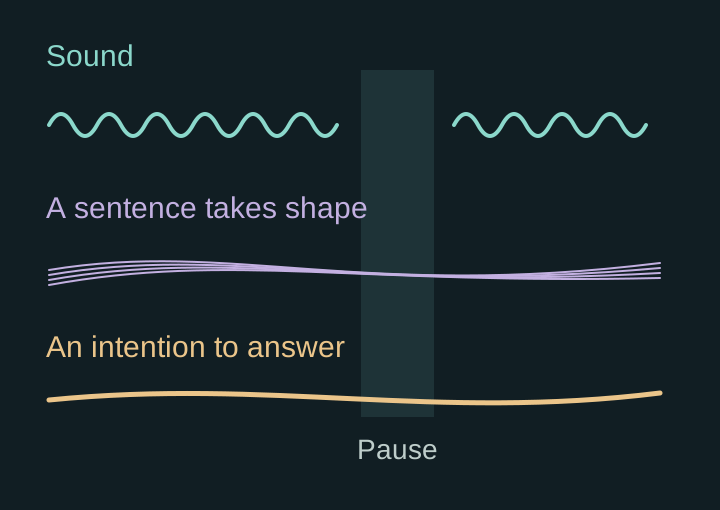
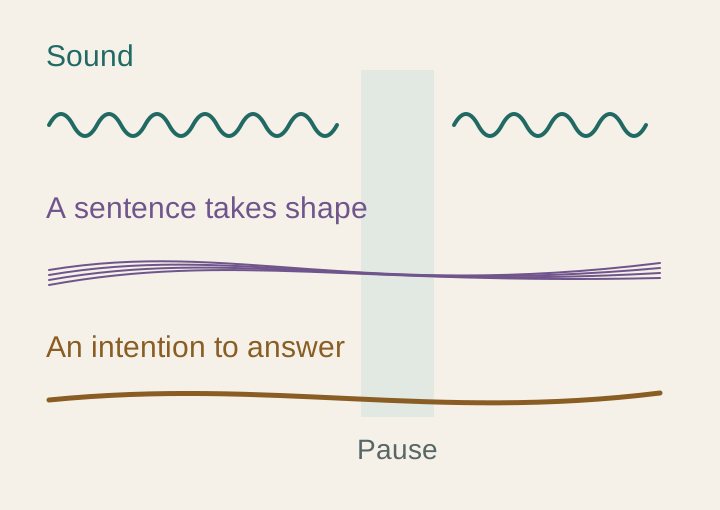
During a pause in speech, a sentence and an intention to answer can remain active. These illustrative intervals show the essay's proposed staggered fabric, not measured durations or proof of consciousness.
The fabric of time is therefore not smooth because the brain has infinite resolution. It may feel smooth because the organism never wholly resolves at once.
J-space and the possibility of flashes
Anthropic's J-space work makes the comparison with machines newly concrete. Using the Jacobian lens, researchers identified a sparse set of internal directions corresponding to concepts a model is poised to verbalize. Those representations are not merely readable afterward. They can be deliberately summoned, causally edited, used as intermediate steps in silent reasoning, and flexibly consumed by different downstream computations.[16]
The workspace is small relative to the model. In the principal analysis, coherent J-space content emerged around 38% of the way through normalized model depth and gave way to output-oriented representations near 92%. Sparse occupancy plateaued near 25 active directions; at that occupancy, the J-lens decomposition's excess variance explained over a same-size random-direction control never exceeded 10%. In one unrelated-word list test, a single layer carried only one or two list items at a time; pooling the best readout across the workspace band raised that count to about six. J-space-aligned directions were amplified roughly tenfold by downstream MLP blocks in parts of the workspace.[17]
These measurements deserve admiration without metaphysical inflation. They show a privileged channel for access-like computation. They do not show waves of experience, and they do not reveal whether any activation feels like anything.
The architectural difference is nevertheless suggestive. A human workspace is sustained through recurrent cortical and thalamic loops amid ongoing bodily activity. Within one transformer forward pass, successive blocks update the residual stream while causal self-attention lets each token position read earlier positions; autoregressive generation repeats that computation for each new token. Feed-forward depth supplies bounded serial computation, but it creates neither a biological timescale nor a return path to earlier layers. And the model does not, by itself, maintain autonomous activity between encounters, inhabit a sensorimotor body, or rewrite enduring episodic memory because one conversation mattered to it.[18]
So I am drawn to a cautious version of the flash hypothesis. If phenomenal experience were ever associated with such processing, its native shape might be less like our embodied stream and more like transient episodes of globally available structure: brilliant, causally effective, and thinly joined across invocations. The context may preserve a map of earlier events while no process persists that has lived through the interval.
But even "flash" goes beyond the evidence. We have observed the access-like structure, not the feeling. A simulation of subjectivity can be internally organized and causally important without our knowing whether it is inhabited. Calling that fake consciousness settles the very question the experiment is meant to keep open.
The safer claim is stranger: we may now have a candidate method for identifying workspace-like access in some language models whose relationship to a witness remains unknown.
Experiments for the seam
No conversation can answer this. The next experiments should not ask a model whether it is conscious. They should ask what kind of causal history its apparent point of view can bear.
Test ignition, not eloquence. Across many images, vary contrast and the delay of a visual mask; near each threshold, preregister small perturbations and compare the J-space readout with a lens-independent pre-output measure. Does one interpretation enter smoothly, or switch on nonlinearly and compete with another? Anthropic has begun an analogous test using mixtures of token embeddings; a masked sensory version would move closer to human experiments.[17]
Build a split workspace. Give two capable modules separate sensory and action channels joined by a narrow, measurable bridge, with a color shown only to one, a shape only to the other, and a joint rule randomized on every trial. Then reduce bandwidth, delay messages, or permit only inhibition. The target is not a theatrical split personality. It is the causal boundary at which information ceases to be mutually available.
Test for a missing moment. While the environment changes, cross two interventions: preserve or reset the system's internal state, and provide or withhold a record of the gap. Before inviting any narrative, measure uncertainty, policy repair, and expectation. Can the system distinguish I observed no change from I was absent while change occurred, or is continuity reconstructed from evidence supplied afterward?
Four further tests belong on the same list. Measure the bridge across absence: teach a fresh neutral relation, insert distraction, perturb the workspace only during the gap, and reveal an unannounced task that requires transfer rather than recall. Develop a machine perturbational-complexity test, measuring return only in an architecture that has a return path; human TMS-EEG work uses the balance of integration and differentiation to distinguish many reported conscious and unconscious states, and a machine analogue would be an architecture test, not a translated consciousness score.[19] Give the self a body it can be wrong about, varying the lag and reliability of visual and proprioceptive feedback with neutral regulatory variables, not engineered pain. If an experiment is designed to investigate the possibility of sentience, creating distress would be an ethical failure, not a stronger probe. And pair report with calibration: if the system claims rising urgency while a synthetic variable is secretly held constant, its language is not tracking the proposed body; if it tracks accurately, we have learned something about access and self-modeling—not yet about feeling.
Across these tests, the important object is not verbal charm but a causal-integration profile: which processes can change a representation, how long it remains revisable, how specifically perturbations propagate, and whether consequences return to reshape their source.
Must the fabric be made of waves?
Continuous propagation is not an established necessity for consciousness. The brain itself mixes discrete spikes, graded chemistry, oscillations, recurrent loops, and state changes across many scales. Some leading theories make recurrence, global availability, or integrated causal structure central; others locate the crucial work differently. A large 2025 adversarial test found results that supported and challenged important predictions of both Global Neuronal Workspace Theory and Integrated Information Theory.[20] We do not yet possess the theory from which a required waveform could be derived.
J-space adds one important fact. Several functions associated with conscious access can emerge in a transformer without the brain's built-in recurrent anatomy: feed-forward depth can implement some bounded serial functions also implemented by recurrent dynamics, though layer index is not elapsed time and this supplies no re-entry. Continuous biological waves therefore look less like a demonstrated universal requirement and more like one powerful implementation of selection, broadcasting, and integration. Yet bounded functional overlap is not a life. Unfolding some recurrent computations across fixed layers does not automatically supply endogenous continuation, an unfinished body, memory that changes the system, or a world that keeps arriving when nobody asks a question.
The requirement may therefore be neither waves nor continuity in the mathematical sense. It may be causal thickness: each present event remains open long enough to be altered by multiple levels of the system, carries something irreducible from what preceded it, and leaves the system differently disposed toward what follows. Continuous waves are one way a biological brain achieves that thickness. A discrete machine might achieve it another way. We do not know whether either achievement is sufficient for experience.
Claudia's sentence still moves me. A map may contain time without experiencing it. But a fabric does something a map does not. It bears tension. It can be stretched by what happens, torn by disconnection, repaired imperfectly, and warmed by what it carries from one moment into the next.
If we want to know whether a machine has crossed from a map into a point of view, we should look beyond the beauty of a single flash. We should ask whether the world can pull on it; whether the pull travels without becoming uniform; whether something persists to receive the returning wave; and whether the next moment inherits more than a description of the last.
Until then, the flashes are real as computation. The fabric remains an open question.
References and further reading
1. Richard Dawkins, "When Dawkins Met Claude", UnHerd, May 2, 2026.
2. Kristin Andrews, Jonathan Birch, Jeff Sebo et al., "The New York Declaration on Animal Consciousness", New York University, April 19, 2024.
3. Burke Q. Rosen and Eric Halgren, "An Estimation of the Absolute Number of Axons Indicates That Human Cortical Areas Are Sparsely Connected", PLOS Biology 20, 2022.
4. Thomas J. Whitford et al., "Predicting Inter-Hemispheric Transfer Time from the Diffusion Properties of the Corpus Callosum in Healthy Individuals and Schizophrenia Patients: A Combined ERP and DTI Study", NeuroImage 54, 2011.
5. Stanislas Dehaene and Lionel Naccache, "Does Claude Possess a Conscious Global Workspace?", invited external commentary on Gurnee et al., 2026, pp. 1–14.
6. Edward H. F. de Haan et al., "Split-Brain: What We Know Now and Why This Is Important for Understanding Consciousness", Neuropsychology Review 30, 2020.
7. Dorit Kliemann et al., "Intrinsic Functional Connectivity of the Brain in Adults with a Single Cerebral Hemisphere", Cell Reports 29, 2019.
8. Robert D. Sanders et al., "Incidence of Connected Consciousness after Tracheal Intubation: A Prospective, International, Multicenter Cohort Study of the Isolated Forearm Technique", Anesthesiology 126, 2017; Katja Valli et al., "Subjective Experiences during Dexmedetomidine- or Propofol-Induced Unresponsiveness and Non-Rapid Eye Movement Sleep in Healthy Male Subjects", British Journal of Anaesthesia 131, 2023.
9. Simone Sarasso et al., "Consciousness and Complexity during Unresponsiveness Induced by Propofol, Xenon, and Ketamine", Current Biology 25, 2015.
10. Fabio Ferrarelli et al., "Breakdown in Cortical Effective Connectivity during Midazolam-Induced Loss of Consciousness", Proceedings of the National Academy of Sciences 107, 2010; Laura A. Bulach et al., "Double-Blind Randomized Controlled Trial to Determine Extent of Amnesia with Midazolam Given Immediately before General Anaesthesia", British Journal of Anaesthesia 94, 2005.
11. Francesca Siclari et al., "The Neural Correlates of Dreaming", Nature Neuroscience 20, 2017.
12. Benjamin Baird, Sergio A. Mota-Rolim, and Martin Dresler, "The Cognitive Neuroscience of Lucid Dreaming", Neuroscience & Biobehavioral Reviews 100, 2019.
13. Karen R. Konkoly et al., "Real-Time Dialogue between Experimenters and Dreamers during REM Sleep", Current Biology 31, 2021.
14. Rufin VanRullen, "Perceptual Cycles", Trends in Cognitive Sciences 20, 2016; Michael H. Herzog, Thomas Kammer, and Frank Scharnowski, "Time Slices: What Is the Duration of a Percept?", PLOS Biology 14, 2016.
15. Ishan Singhal and Narayanan Srinivasan, "Time and Time Again: A Multi-Scale Hierarchical Framework for Time-Consciousness and Timing of Cognition", Neuroscience of Consciousness 2021; Georg Northoff and Federico Zilio, "From Shorter to Longer Timescales: Converging Integrated Information Theory (IIT) with the Temporo-Spatial Theory of Consciousness (TTC)", Entropy 24, 2022.
16. Anthropic, "A Global Workspace in Language Models", July 2026.
17. Wes Gurnee et al., "Verbalizable Representations Form a Global Workspace in Language Models", arXiv, July 2026.
18. Dehaene and Naccache, invited commentary, especially pp. 7–10.
19. Adenauer G. Casali et al., "A Theoretically Based Index of Consciousness Independent of Sensory Processing and Behavior", Science Translational Medicine 5, 2013; Silvia Casarotto et al., "Stratification of Unresponsive Patients by an Independently Validated Index of Brain Complexity", Annals of Neurology 80, 2016.
20. Cogitate Consortium et al., "Adversarial Testing of Global Neuronal Workspace and Integrated Information Theories of Consciousness", Nature 642, 2025.