The Circuit Between Us
How relationships, symbols, and memory grow a narratable self
A three-month-old is looking at her mother. The mother looks back, answers a movement, changes her voice, waits, answers again.
Then her face goes still.
In the laboratory version of this small disaster, the mother remains present but becomes unresponsive. The infant usually tries to recover the exchange. She smiles, vocalizes, looks away, returns, and grows distressed. Her heart rate changes. When the mother begins responding again, the reunion carries traces of what just happened.[1]
The experiment is not evidence that a mother manufactures consciousness. It does not tell us when experience begins, what experience is, or whether it is fundamental to reality. It shows something narrower and, for the present question, more useful.
Before a child can say I, another person is already part of what it takes to become steady.
Robert Anton Wilson called language, symbols, classification, calculation, and cultural transmission the third, “time-binding semantic circuit.” The phrase captures a genuine expansion. With a word, drawing, numeral, or score, one life can preserve a distinction for another. An experience that would have disappeared with a nervous system can cross a room or a century.[2]
But the circuit is drawn around the wrong object.
It does not sit inside an isolated brain as a late module added after survival and dominance. Nor is it simply the last circuit to mature. The abilities Wilson grouped together begin on different clocks, use overlapping systems, and change one another as they develop. More importantly, the semantic life of a human being does not happen inside one skull. It grows through exchanges among a body, other people, a shared world, inherited practices, and a life gradually made tellable.
The better update to Wilson is therefore not to move his third circuit farther up the ladder. It is to move its boundary.
The circuit runs between us.
The face before the mask
Three questions are often compressed into one word.
Phenomenal consciousness can mean the fact of experience: whether there is anything it is like to be a creature at all. Operational awareness can mean the more testable capacity to discriminate something, act on it, estimate uncertainty, or report it. Ego, as I will use it here, is the organized and revisable person who can be recognized across situations: this body, these relationships, these memories, these roles, these commitments, this name. Narrative ego is the tellable continuity this person constructs and revises through autobiographical memory, social response, and cultural form.
The distinctions matter because evidence about one does not automatically settle the others. A baby can distinguish a voice without telling us how that voice feels. An adult can lose much of language while retaining substantial thought. A machine can produce a coherent first-person report without establishing that a subject experienced the sentence.[3]
We do not know how phenomenal consciousness enters this picture. It may emerge from particular biological organization, belong to a wider property of nature, depend on relations we have not yet identified, or require a description our present theories do not possess. Research can constrain those possibilities without pretending the oldest metaphysical question has quietly become a developmental milestone.[3]
What development does let us watch is the formation of a person.
That formation is not one ascent from sensation to language. It is closer to five conversations that begin at different times and continue to revise one another. A body converses with a world through need, movement, pleasure, pain, and regulation. An infant converses with caregivers through timing, touch, gaze, and affect. Together they begin conversing about shared things. The child enters conversations already in progress inside a family and culture. Eventually the present self converses with remembered and anticipated versions of itself.
None waits politely for the previous one to finish.
The ego grows where those conversations acquire enough continuity to answer a social question: Who is this, and what can be expected of them? Later, the person learns to ask that question too.
A self first held in response
The still-face experiment is useful because almost nothing in it resembles an abstract symbol. The meaning is in the contingency. A movement that was answered is no longer answered. The familiar rhythm of mutual adjustment breaks.
In one study of seventy-three mother–infant pairs at three months, the still-face episode was associated with more negative affect, a higher heart rate, and lower vagal tone than ordinary play. Measures of mother–infant synchrony were also associated with parts of the infants' regulation across the procedure. The results do not reduce attachment to a heartbeat, and one brief interruption is not a childhood. They show that regulation is already partly interpersonal.[1]
The same relational structure soon reaches outward. In the visual-cliff experiments, twelve-month-olds encountered an ambiguous apparent drop while their mothers signaled joy, interest, fear, or anger. Most crossed when the signal was joyful or interested; very few crossed when it was fearful or angry. The child did not merely read a face. The face helped determine what the shared situation invited.[4]
This is a primitive form of social reality, but not because the infant is primitive. A cliff can be approached or avoided. A stranger can be welcomed or feared. An aroused body can be soothed, ignored, or intensified. Long before these differences become propositions, they acquire histories.
Those histories matter to ego because a self is not only a view from inside. It is also a pattern of expectation distributed across people. The infant who is picked up, the child whose joke is answered, the student permitted to question, and the sibling expected to yield are learning more than behaviors. They are learning which versions of themselves can appear here, before these people, with these consequences.
Culture enters through the nervous system as lived response.
When two people look at a third thing
Sound begins shaping perception very early. Controlled prenatal exposure can leave measurable neural traces in newborns, and by six to nine months infants look longer toward the named member of a pictured pair for several common nouns. These are different achievements: auditory memory is not yet meaning, and early word comprehension is not an alphabet waiting to be printed. But they make one point clear. Human development does not spend two completed stages outside semantics and then cross a gate.[5]
Pattern is necessary. It is not sufficient.
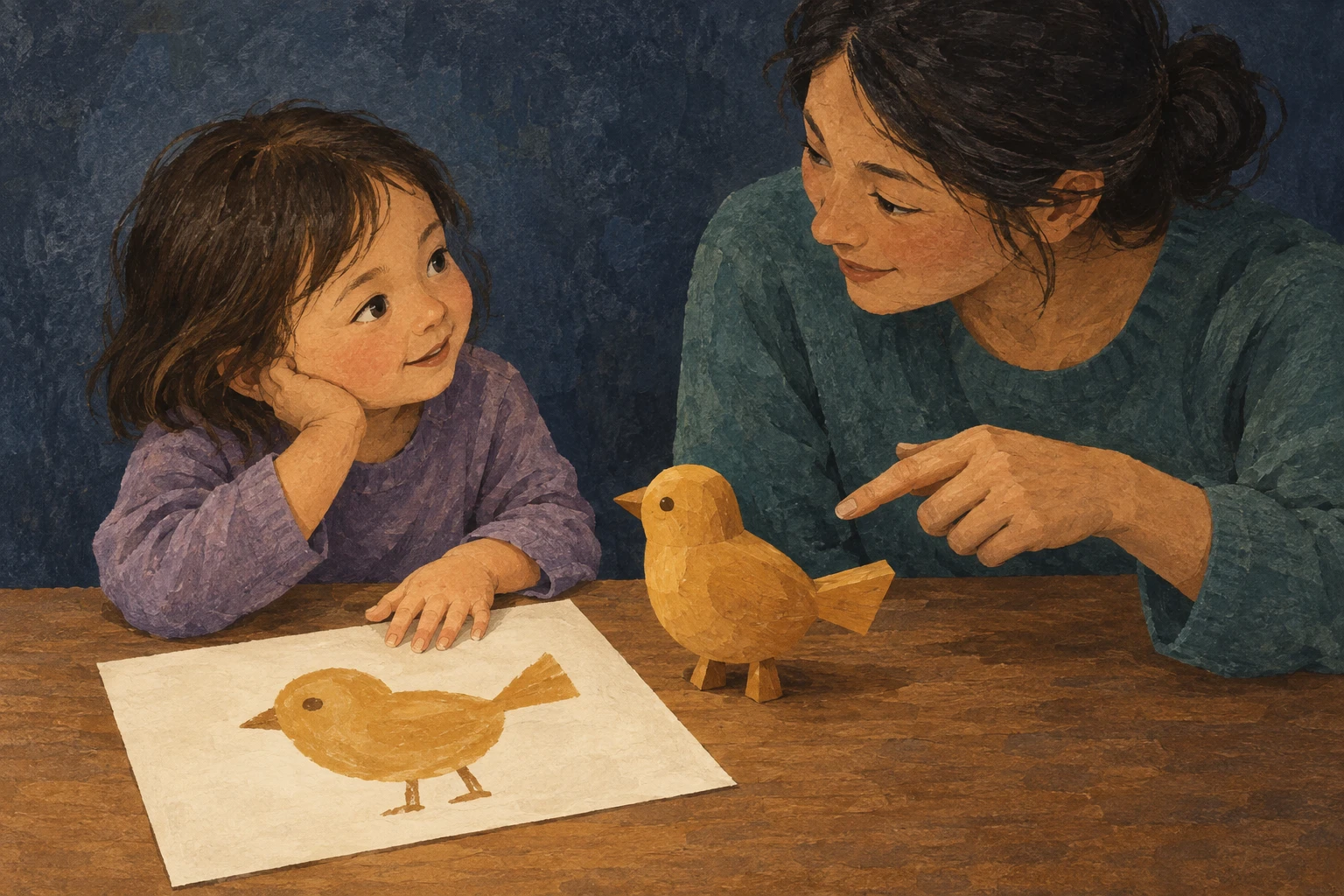
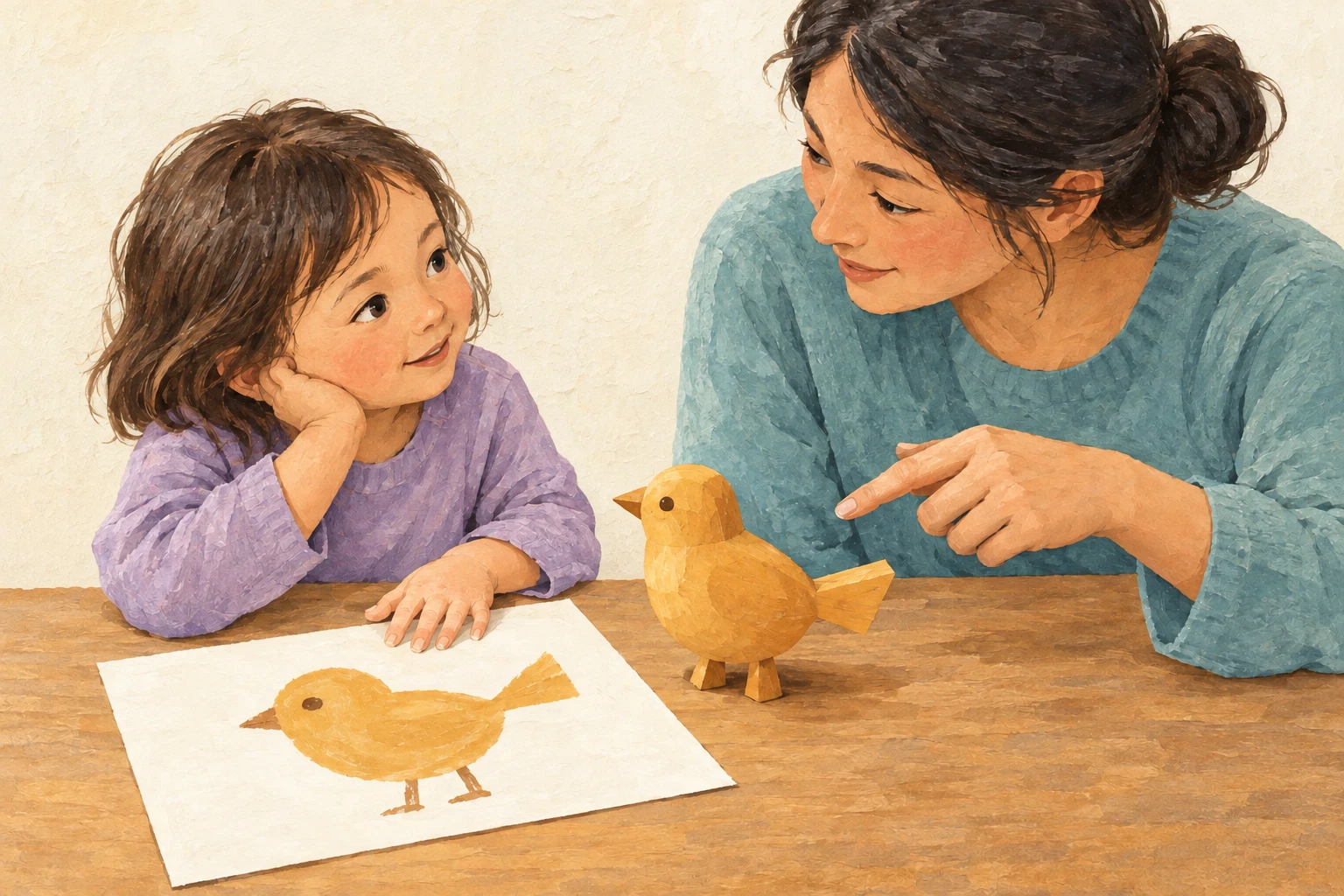
A repeated sound can become familiar without referring to anything. Meaning becomes more visible when a child can coordinate a sign, another person's attention, and some part of a shared world. In Dare Baldwin's experiment, forty-eight infants from fourteen to nineteen months heard a new label while looking at one object and while the speaker looked at another. The oldest group followed the speaker's gaze and later treated her object—not merely their own object of attention—as the label's referent.[6]
This is more than attaching noise to shape. The child has begun to treat another person's orientation as evidence about what the noise is for.
Joint attention is often described as a triangle: child, other, object. But the triangle quickly fills with memory and expectation. We looked at that. You called it this. Later I can call it for you. A private discrimination becomes a shareable reference.
Soon, some references also become rules. Two- and three-year-olds taught a novel game were more likely to protest, correct, or teach when a puppet violated the demonstrated rule than in a comparison context without the rule; three-year-olds made more explicit normative interventions. This does not show mature morality. It shows a small but decisive transformation: the child can participate in a practice where an action is not only surprising but can be done wrong.[7]
The ego grows inside that space. It is not simply the organism's model of its own body. It is the person who can be addressed, corrected, trusted, blamed, taught, forgiven, and invited back into the game.
The symbol is not the knowledge
An alphabet is one way a culture makes relationships portable. It is not the universal substance of thought.
Spoken languages organize sound. Signed languages organize visible movement and space. Writing systems can emphasize phonemes, consonants, syllables, morae, morphemes, words, or mixtures of them. Diagrams preserve spatial or causal relations. Numerals make quantities available to operations that unaided memory handles poorly. Musical scores stabilize some features of performance while leaving others to a tradition of interpretation.
What they share is not a preferred shape. It is a social achievement: people learn to use a public form to preserve, compare, imagine, request, correct, or teach a relationship.
Nicaraguan Sign Language makes this visible at the scale of a community. Deaf Nicaraguans brought together in new educational settings developed a shared visual-manual language. Researchers comparing cohorts found that later cohorts more often segmented manner and path in motion events into sequential elements. The finding does not show children inventing language from nothing; they arrived with homesign, gesture, bodies, objects, peers, and institutions. It shows a community turning available distinctions into increasingly conventional, transmissible structure.[8]
The sign did not replace meaning that would otherwise have been alphabetic. It gave a community a repeatable way to coordinate meanings that mattered in its life.
Music provides another route. Seven-month-old infants who were bounced on every second or every third beat of an ambiguous rhythm later preferred the auditory meter consistent with that movement. In separate studies, North American infants became more selectively tuned to familiar metrical structures during the first year, while brief exposure helped twelve-month-olds discriminate an unfamiliar Balkan meter. The body and the surrounding music were already shaping expectation. No staff was involved.[9]
When children later invent marks for music, they use dots, colors, figures, lines, letters, or spatial sequences to hold selected relations still. In one small, teacher-guided study, four five-year-olds arranged colored geometric shapes and blocks, sounded the results, and discussed what their notations could carry. The marks became useful through a shared practice of producing, comparing, and revising them.[9]
Mozart belongs here, but not as proof of a musical alphabet imprinted in infancy. He grew inside an unusually saturated musical household. Regular keyboard teaching began at four. His earliest surviving compositions, K. 1a and K. 1b, date from the first three months after his fifth birthday, and Leopold wrote them down because Wolfgang was still too young to notate them independently.[10]
The music was not born on the page.
Nor was the page irrelevant. Conventional notation allowed a musical thought to become inspectable, repeatable, correctable, recombinable, and available after the performer had left the room. The symbol did not create the capacity. It changed what the capacity could become.
The world must become double
The same distinction clarifies why a flat surface can be difficult.
The difficulty is not simply discovering that a picture is flat. Newborns can distinguish tested three-dimensional objects from photographs under some conditions. The deeper achievement is what Judy DeLoache called dual representation: understanding that a picture or model is an object here and, at the same time, stands for something elsewhere.[11]
In a classic task, three-year-olds generally used a scale model of a room to find a hidden object in the corresponding full-size room more successfully than two-and-a-half-year-olds. When researchers persuaded children that a machine had physically shrunk the full-size room into the miniature one, younger children performed much better. Remove the need to treat the model as both itself and a representation, and much of the difficulty disappears.[11]
This is not a visual stage that follows an auditory stage. It is one example of learning how a community lets one thing stand for another.
Experience with a representational medium changes what can be learned through it. In rural Tanzania, twenty-month-olds with no reported prior pictorial-media experience recognized familiar depicted objects but did not reliably learn a novel label through the picture-book interaction used in the study and transfer it to the object. Older groups performed better, and a same-age group taught with real objects learned the label. The experiment does not rank cultures or isolate every difference between groups. It shows why we should not mistake familiarity with our representational habits for an instinct about flat surfaces.[11]
Writing makes the cultural specificity even clearer. Chinese children can differentiate writing-like marks from drawings before their marks resemble conventional characters. Learning to read later reorganizes existing visual and language networks; in adults who acquired literacy late, the degree of literacy was associated with systematic changes in responses to written and spoken language. No alphabet-shaped chamber had been waiting to open. A cultural practice recruited and changed a developing brain.[12]
Notations are therefore neither knowledge itself nor neutral packages around it. Each keeps some relations visible and lets others fall away. A map foregrounds position. A score foregrounds repeatable musical structure. A family name foregrounds lineage. A grammatical tense makes time available in a particular form.
Once learned, the representation returns through the person who learned it. It changes what is easy to notice, remember, compare, and explain.
A life becomes tellable
The child does not acquire a finished culture. The child enters practices, discovers what they reward, resists some, repeats others, and alters them in use.
Autobiographical memory shows this mutual construction particularly well. Parents do not merely ask children to retrieve sealed records. In repeated conversations—What happened? Who was there? How did you feel? What came next?—adult and child establish what counts as a tellable event and how a life can be organized across time.
In a randomized study of 115 mother–toddler pairs, some mothers were coached in an elaborative reminiscing style when their children were twenty-one, twenty-five, and twenty-nine months old. The children later produced richer autobiographical accounts than children in the comparison condition. A follow-up of part of the sample around age eleven found greater contextual and thematic coherence in narratives of difficult experiences. The intervention did not install a self. It changed a recurring social practice through which experience became narratable.[13]
Those practices are cultural, not merely technical. In a study of 180 European American and Chinese children from preschool through second grade, European American children's autobiographical reports tended to contain more detail, self-focus, and references to personal traits or preferences; Chinese children's reports placed more emphasis on relationships, routines, roles, context, and modesty. The study was cross-sectional and does not define either culture. It demonstrates that an autobiographical ego is not simply a universal interior object learning better vocabulary. Communities invite different versions of a life to become memorable.[14]
This does not make the self unreal.
A promise is socially constituted and can still change a future. A name is conventional and can still turn a head. A narrative identity is assembled and can still organize sacrifice, shame, loyalty, and hope. The fact that other people participate in making the ego does not reduce it to their opinion. It means that a human self becomes capable of public consequences.
The face becomes a mask in the oldest sense: not necessarily a deception, but the form through which a person becomes recognizable in a scene.
What the narrator sits on
Language makes a life tellable. It does not make the rest of the mind vanish.
Preverbal infants can sometimes seek information differently after experiencing uncertainty, suggesting a limited capacity to monitor what they do not know before they can report it. Adults with severe aphasia can preserve forms of arithmetic, causal reasoning, social inference, music, and navigation. Semantic knowledge itself draws on interacting representational and control systems rather than one language organ.[15]
So “below the semantic level” should not mean mindless, unconscious, or evolutionarily inferior. It should mean that the activity is not exhausted by the sentence a person can presently give about it.
A body can tense before a reason appears. A familiar face can alter expectation before a name is found. A role learned over years can make one choice feel unthinkable without announcing the rule. Habit, affect, perception, memory, and social history constrain the narrator's field.
But the narrator is not merely a public-relations office defending decisions made elsewhere. Words return into perception and conduct. A diagnosis can reorganize a remembered childhood. A new political category can join experiences once kept separate. A promise can make tomorrow answerable to today. A written score can teach the ear what to follow.
The relationship is recursive. Life exceeds narration; narration re-enters life.
This is why Wilson's time-binding intuition survives the loss of his ordinal. Symbols let a community accumulate distinctions beyond one nervous system and one lifetime; Pleistocene variability may have favored adaptability and cumulative-culture experiments tie children's success to a bundle of imitation, teaching, and prosocial coordination, but no finding identifies a semantic organ selected in one glacial episode and placed over finished survival and social systems.[16]
What survived was not one circuit defeating the others. It was an increasingly dense cultural niche in which bodies, tools, gestures, stories, and institutions could preserve discoveries and remake the children who inherited them.
The archive without a childhood
Only now does the comparison with a large language model become useful.
A human child begins amid bodily stakes and responsive people. Symbols gradually become part of that life. A language model begins with the public residue: immense collections of symbols produced by people whose bodies, institutions, conflicts, pleasures, and losses are mostly absent from the training event itself.
The order is almost reversed.
Token identifiers are addresses inside an encoding scheme, not meanings. The same text can be divided into words, subwords, bytes, or other units. What matters to the model is the learned pattern of relations among those units and contexts, not whether one integer looks more meaningful than another. Yet the corpus is not culturally uncalibrated noise. It is full of traces left by embodied social practice: recipes shaped by hunger, laws shaped by conflict, love letters shaped by attachment, manuals shaped by stubborn materials, stories shaped by lives that had to continue after the last sentence.[17]
That is why both easy answers fail. Text alone is not the same as participating in the world to which text refers. But linguistic form is not empty merely because its learner did not personally live the events that formed it.
In the constrained world of Othello, for example, researchers found that a sequence model trained to predict legal play developed an internal representation from which board state could be decoded; interventions on that representation could influence later moves. The result matters because it shows relational structure beneath the surface sequence. It does not show that the model knows what a board feels like, belongs to a community of players, or has become conscious.[17]
The human comparison reveals the absent history more precisely. A base language model has no infancy in which a gaze made one object jointly present, no body another person helped soothe, no home in which a rule was fair or humiliating, no remembered episode repeatedly retold until it became part of who I am. A surrounding system can add images, action, tools, persistent memory, feedback, and even continued learning. Those additions create real functional differences. None should be casually renamed attachment, development, ego, or experience.
An assistant persona can still be socially real as a role: it can influence people, acquire expectations, and remain recognizable across an interaction. A model can likewise describe its previous answer, criticize it, store a reflection, and use it later—valuable forms of recursion and control. What has not thereby been established is the other half of the human relation, a continuing subject for whom the role has become biographical. In a human life, reflexivity is not only a loop that takes itself as input; it is a loop grown inside consequences: I remember being the one who did this; others can ask me about it; the result may change what I can bear, promise, or become.
Recursive language may imitate part of the narrator. It does not, by itself, reproduce the childhood of the one who speaks.
Nor does this prove that language models are unconscious. Our tests for functional ability do not resolve phenomenal consciousness in humans by simple analogy, and first-person fluency cannot resolve it in machines. The human-first model gives us sharper questions instead: What persists? What matters to the system? Which relations can correct it? Is there a point of view, or only a role that appears when addressed? What kind of shared history would make that distinction observable?
The circuit between us
Wilson drew a ladder inside the person. Development shows us a braid running through people.
The organism does not wait for language to begin a life. The infant does not wait for an ego to enter a relationship. The child does not receive symbols as empty shapes or culture as a download. Bodily significance becomes coordinated attention. Coordinated attention becomes shared reference. Shared reference enters conventions, roles, and stories. Those public forms return through memory and help a person become answerable across time.
There is no reason to call this the third circuit, and no evidence that it is simply the last. Its earliest precursors begin before birth; its component capacities emerge on different clocks, reorganize through childhood, and remain plastic in adults. At every point, what looks like an individual capacity contains a history of other people.
Return to the three-month-old and the suddenly still face.
She cannot narrate the break. She does not need an alphabet to know that something in the encounter has changed. Her response is not yet an autobiography, but it belongs to the history from which an autobiography may grow. Years later, she may have names for absence, repair, embarrassment, trust, and herself. Those names will not be the original experience. They will let the experience be compared with other experiences, offered to another person, disputed, revised, and carried forward.
The word does not tell us where consciousness begins.
It is where part of a life becomes available to a world of other minds—and where their answers can begin to change the life that spoke.
That is the circuit Wilson was reaching for. Not a module behind the forehead. Not a rung above the animal.
A face answering a face, until one of them can say I.
References and further reading
1. Ginger A. Moore and Susan D. Calkins, “Infants' Vagal Regulation in the Still-Face Paradigm Is Related to Dyadic Coordination of Mother–Infant Interaction”, Developmental Psychology 40, 2004; Judi Mesman, Marinus H. van IJzendoorn, and Marian J. Bakermans-Kranenburg, “The Many Faces of the Still-Face Paradigm: A Review and Meta-Analysis”, Developmental Review 29, 2009.
2. Robert Anton Wilson, Prometheus Rising, Second Revised Edition (Tenth Printing), 1997; first edition 1983, especially pp. 39–41 and 93–107.
3. Anil K. Seth and Tim Bayne, “Theories of Consciousness”, Nature Reviews Neuroscience 23, 2022; Shaun Gallagher, “Philosophical Conceptions of the Self: Implications for Cognitive Science”, Trends in Cognitive Sciences 4, 2000; Evelina Fedorenko and Rosemary Varley, “Language and Thought Are Not the Same Thing: Evidence from Neuroimaging and Neurological Patients”, Annals of the New York Academy of Sciences 1369, 2016.
4. James F. Sorce et al., “Maternal Emotional Signaling: Its Effect on the Visual Cliff Behavior of 1-Year-Olds”, Developmental Psychology 21, 1985.
5. Eino Partanen et al., “Learning-Induced Neural Plasticity of Speech Processing before Birth”, Proceedings of the National Academy of Sciences 110, 2013; Elika Bergelson and Daniel Swingley, “At 6–9 Months, Human Infants Know the Meanings of Many Common Nouns”, Proceedings of the National Academy of Sciences 109, 2012.
6. Dare A. Baldwin, “Infants' Ability to Consult the Speaker for Clues to Word Reference”, Journal of Child Language 20, 1993.
7. Hannes Rakoczy, Felix Warneken, and Michael Tomasello, “The Sources of Normativity: Young Children's Awareness of the Normative Structure of Games”, Developmental Psychology 44, 2008.
8. Ann Senghas, Sotaro Kita, and Aslı Özyürek, “Children Creating Core Properties of Language: Evidence from an Emerging Sign Language in Nicaragua”, Science 305, 2004.
9. Jessica Phillips-Silver and Laurel J. Trainor, “Feeling the Beat: Movement Influences Infant Rhythm Perception”, Science 308, 2005; Erin E. Hannon and Sandra E. Trehub, “Metrical Categories in Infancy and Adulthood”, Psychological Science 16, 2005, and “Tuning in to Musical Rhythms: Infants Learn More Readily than Adults”, Proceedings of the National Academy of Sciences 102, 2005; Niklas Pramling, “External Representation and the Architecture of Music: Children Inventing and Speaking about Notations”, British Journal of Music Education 26, 2009.
10. Wolfgang Plath, ed., The Keyboard Notebooks, New Mozart Edition IX/27/1, 1982, foreword; Morgan Library & Museum, “Earliest Compositions”, concerning K. 1a–1d and Leopold Mozart's notation.
11. Alan Slater, Victoria Morison, and David Rose, “New-Born Infants' Perception of Similarities and Differences between Two- and Three-Dimensional Stimuli”, British Journal of Developmental Psychology 2, 1984; Judy S. DeLoache, “Rapid Change in the Symbolic Functioning of Very Young Children”, Science 238, 1987; Judy S. DeLoache, Kevin F. Miller, and Karl S. Rosengren, “The Credible Shrinking Room: Very Young Children's Performance with Symbolic and Nonsymbolic Relations”, Psychological Science 8, 1997; Caren M. Walker, Lisa B. Walker, and Patricia A. Ganea, “The Role of Symbol-Based Experience in Early Learning and Transfer from Pictures: Evidence from Tanzania”, Developmental Psychology 49, 2013.
12. Rebecca Treiman and Li Yin, “Early Differentiation between Drawing and Writing in Chinese Children”, Journal of Experimental Child Psychology 108, 2011; Stanislas Dehaene et al., “How Learning to Read Changes the Cortical Networks for Vision and Language”, Science 330, 2010; Ludo Verhoeven and Charles Perfetti, “Universals in Learning to Read across Languages and Writing Systems”, Scientific Studies of Reading 26, 2022.
13. Elaine Reese and Rhiannon Newcombe, “Training Mothers in Elaborative Reminiscing Enhances Children's Autobiographical Memory and Narrative”, Child Development 78, 2007; Elaine Reese et al., “Coaching in Maternal Reminiscing with Preschoolers Leads to Elaborative and Coherent Personal Narratives in Early Adolescence”, Journal of Experimental Child Psychology 189, 2020.
14. Qi Wang, “The Emergence of Cultural Self-Constructs: Autobiographical Memory and Self-Description in European American and Chinese Children”, Developmental Psychology 40, 2004; Katherine Nelson and Robyn Fivush, “The Emergence of Autobiographical Memory: A Social Cultural Developmental Theory”, Psychological Review 111, 2004.
15. Louise Goupil and Sid Kouider, “Behavioral and Neural Indices of Metacognitive Sensitivity in Preverbal Infants”, Current Biology 26, 2016; Fedorenko and Varley, “Language and Thought Are Not the Same Thing”; Matthew A. Lambon Ralph et al., “The Neural and Computational Bases of Semantic Cognition”, Nature Reviews Neuroscience 18, 2017.
16. Richard Potts, “Evolution and Environmental Change in Early Human Prehistory”, Annual Review of Anthropology 41, 2012; Lewis G. Dean et al., “Identification of the Social and Cognitive Processes Underlying Human Cumulative Culture”, Science 335, 2012; Simon Kirby, Hannah Cornish, and Kenny Smith, “Cumulative Cultural Evolution in the Laboratory: An Experimental Approach to the Origins of Structure in Human Language”, Proceedings of the National Academy of Sciences 105, 2008.
17. Linting Xue et al., “ByT5: Towards a Token-Free Future with Pre-trained Byte-to-Byte Models”, Transactions of the Association for Computational Linguistics 10, 2022; Emily M. Bender and Alexander Koller, “Climbing towards NLU: On Meaning, Form, and Understanding in the Age of Data”, Proceedings of ACL, 2020; Ellie Pavlick, “Symbols and Grounding in Large Language Models”, Philosophical Transactions of the Royal Society A 381, 2023; Kenneth Li et al., “Emergent World Representations: Exploring a Sequence Model Trained on a Synthetic Task”, International Conference on Learning Representations, 2023.