Build a Loop That Changes You
A small practice in two directions
Part I separated an incident from the story attached to it, and asked which lines of your own account you saw and which you supplied. Part II asked whether a map that keeps correcting itself could ever become a point of view. This part is smaller. It asks what one person does with one reaction, again and again, so that the map gets more honest and the person gets a little freer.
Picture a simple chart. Across it runs action, or outer agency: taking part in what happens. Up it runs letting go, or inner agency: noticing the tension or demand inside and loosening its hold. The chart is a metaphor for practice, not a measure of a person. We can act furiously while remaining caught in the same fear. We can also become good at watching our reactions while leaving everything that matters untouched.
Imagine a hillclimb made of two kinds of step, taken in turn. One step right: a real act, with real people in it, that can go wrong. One step up: a pause in which the tension shows itself, the story attached to it becomes noticeable, and you let go just enough for the next choice to be yours. Then right again. Then up again. Neither step needs to be large. The alternation is the practice.
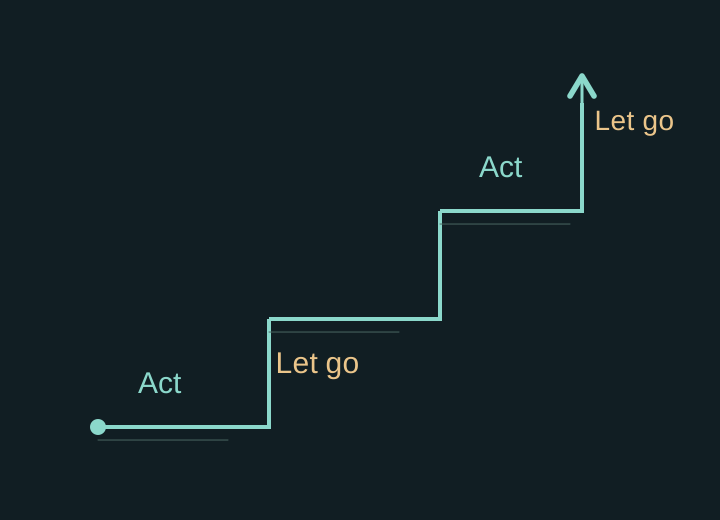
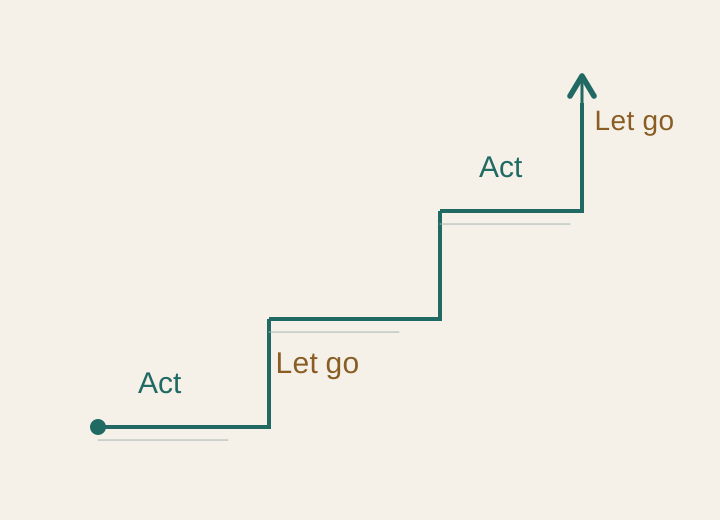
Two directions to return to, not a promise that each day carries us higher.
Here is one ordinary run of it. The example is invented, though I expect it will feel familiar.
There is a friend you have not spoken to in years. No falling out; the years just did it. You think of them more than you admit. In a series of surveys and experiments, researchers found that people hesitate to contact old friends even when they want to and expect it to go well. Nothing happens, and the not-happening starts to feel like a fact about the friendship.
Step right. Write one message. Short, specific, with nothing demanded: Walked past the old place today and thought of you. How are you these days? If you want to reconnect, you can send it while a little uncertainty remains.
Step up. Before you check for a reply, sit with what the sending did. The chest is tight. The phone is still in your hand. There is a sentence already forming: if they have not answered by tonight, I was right not to bother all those years. Write the incident on one line: I sent a message at four o'clock. Write the story on the next: they will not answer, and that will prove something. Notice which role has arrived to read the silence: the one who gets forgotten. Then let go, not of the wanting, only of the demand that the reply come now and come warm. Enough to put the phone face down. That is all inner agency needs to mean here.
Step right again. If they answer warmly, propose one short walk on one named day. If they decline or do not answer, leave them room. The next act may be putting the phone away and returning to your afternoon. Agency does not entitle you to their attention.
Step up again. A reply can stir as much as silence. Notice the urge to make one walk prove that the friendship is restored, or one unanswered message prove that you were never wanted. See whether you can hold I do not yet know without filling it in.
The act has to meet consequences you cannot control. The pause makes room to choose how you respond. Some days the outward step is tiny and the tension does not loosen at all. You can notice that too, without turning the practice into another demand.
Try it with one small thing you care about. Do what is yours to do. Pause long enough to feel your feet on the floor and name the story that arrived. Let go of one demand you cannot enforce. Then choose the next step from what actually happened.
Nothing here promises that you will improve and stay improved. Agency of this kind lives alongside limits. The friend's reply belongs to the friend. What is yours is that you did the thing and then chose how to hold the result.
The earlier essays left open what consciousness ultimately is. This practice can leave that question open too. What one run of the loop can show is more modest. The incident was not the story. The story did not decide the action. And the person who put the phone face down is not quite the person who stood braced against sending.