Can a Map Become a Witness?
Workspaces, compression, and engineered reflection


Figure 1. A finite system must lose detail to remain oriented. The open question is whether continuously making that boundary can ever become experience. Original illustration.
A map can guide action without feeling the ground beneath it.
In Part I, I drew two arrows through the same stack: substrate, adaptive mind, and possible subject. The bottom-up arrow asks how matter could become a witness. The top-down arrow asks how a witness could become expressed through matter. Both pass through the same finite interface. Whatever the direction of explanation, no bounded system contains the territory it inhabits.
Now we can ask the more dangerous question: could the continuous construction and revision of a map ever become a point of view?
The argument that follows is intentionally asymmetric. I will begin with facts about observable function, move into a hypothesis about compression and integration, and keep phenomenal experience on the far side of an evidence boundary. The hypothesis is not that current AI is conscious. It is that the boundary between what a system cannot contain and what it must integrate to act may be a more useful place to look than fluency alone.
Then I will bring the idea back down to engineering. We do not need to solve consciousness to build better agents. We need to make their maps answerable to a world that can say no.
The missing ingredient
Suppose the bottom-up arrow is basically right. What must align before consciousness emerges?
First, split the word consciousness in two. Access consciousness is information available for report, reasoning, and action. Phenomenal consciousness is the felt quality of experience: the redness of red, the ache of pain, the fact that there is something it is like to be you.[1]
Access can be studied from outside. Feeling is directly available only to the subject. Almost every argument about AI consciousness eventually falls into that gap.
Researchers therefore look for indicators rather than a magic test. A 2025 interdisciplinary review derived candidate indicators from leading scientific theories of consciousness while emphasizing how uncertain those theories remain.[2] Four groups recur:
Availability: Selected information can reach many parts of the system instead of remaining trapped in one process.
Continuity: Memory and recurrent processing connect one moment to the next and let the present revise what came before.
Self and world: The system represents its own boundary, uncertainty, action, and place in an environment.
Stakes: The system changes its behavior to preserve some internal conditions and avoid others, even when no operator intervenes.
These are indicators, not a recipe for feeling. A database has memory; a thermostat has a boundary and goal; a language model can report uncertainty. Combining functions does not automatically summon experience.
Even our leading biological theories are unsettled. In 2025, a large adversarial collaboration tested predictions of Global Neuronal Workspace Theory and Integrated Information Theory. Some predictions survived, some did not, and one result considered critical to both supported neither.[3] If we do not yet agree on the mechanism in humans, certainty about its presence or absence in a machine should remain modest.
A workspace, not yet a witness
This is why Anthropic’s recent J-space work is fascinating.
In July 2026, researchers introduced the Jacobian lens, a way to identify a small set of internal concepts that a language model is poised to use or verbalize. They call the resulting representational space J-space. It is not written chain-of-thought, and it is not a secret sentence hidden inside the network.[4][5]
Researchers can add or remove these activation patterns and change flexible, multi-step reasoning while leaving much routine language intact. J-space contents can be summoned, held during another task, reported, and used downstream. The analogy to a workspace is tempting: much happens in the background while a narrow selection becomes available to the task as a whole.
It also returns us to the mask. The researchers report that pretraining appears to produce the workspace, while post-training installs the Assistant’s point of view inside it. The role is not merely painted on the output; it helps organize part of the model’s usable internal state.
But functional access is not felt experience. J-space is not a complete transcript of inner life, its contents are limited by what the method can decode, and the work is new enough that replication and competing interpretations matter. Anthropic explicitly stops at functional parallels to conscious access; it does not claim that Claude feels.[4]
Google DeepMind’s Gemma Scope offers a complementary way to separate mixed internal activity into more interpretable features.[6] Neither method reveals a witness. Together, they show that the machinery between prompt and answer has more reusable structure than “autocomplete” suggests and less transparency than a convincing self-report implies.
The narrow result is remarkable enough: a workspace-like organization emerged through training rather than being explicitly programmed. The deeper question is whether enough such organization can cross a qualitative boundary—or whether no organization of functions can cross it at all.
Consciousness as compression at the boundary
Now the speculation.
A finite mind cannot contain the world, so it must preserve a usable map: what matters, what changed, what happened to me, and what should happen next. Consciousness could be less like a complete internal movie and more like the continuous making of that limited point of view—the compression of an open-ended, perhaps not fully computable territory into a finite state from which action is possible.
Compression does not mean that an uncomputable process has become computable. A map does not become the territory by becoming more detailed. It means that a bounded system forms a useful, lossy projection of what it cannot reproduce in full.
Machine learning offers an analogy, not evidence. A language model’s predictive probabilities can be used for lossless data compression, formally linking prediction and compression; this does not mean the model never memorizes examples or that its weights are simply a compressed archive. Earlier memory research also explored retaining coarse, useful traces of old activity rather than retaining it all.[7][8]
J-space suggests a second and more temporary bottleneck. From distributed activity, a limited set of concepts becomes available for report and flexible use. It is not known to exist because the training corpus cannot fit inside the weights, and it cannot recover details training failed to encode. It integrates what the model learned with what the present context makes relevant now.
Reflection adds one more turn. When a model can hold a task, its last judgment, a model of its role, and an alternative judgment in the same context, one representation can act on another; experiments show that models can even choose and combine problem-solving structures before using them.[9]
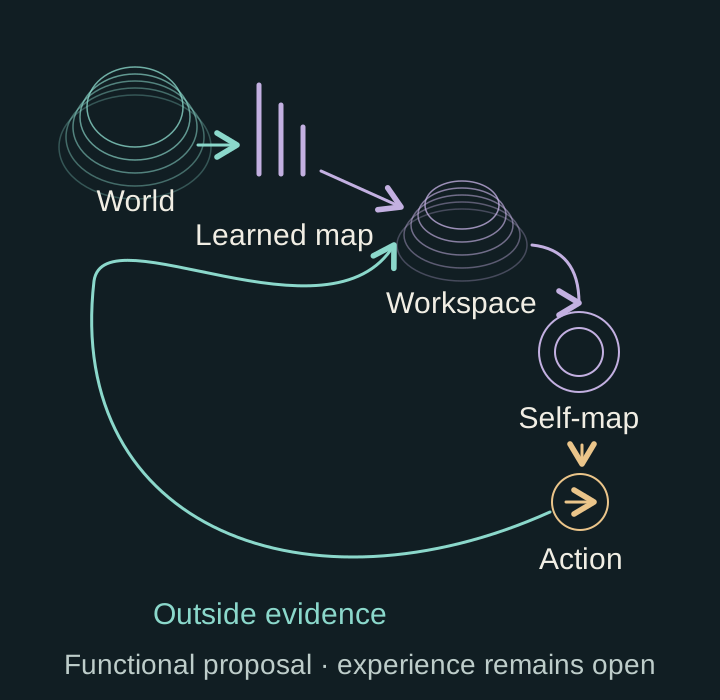
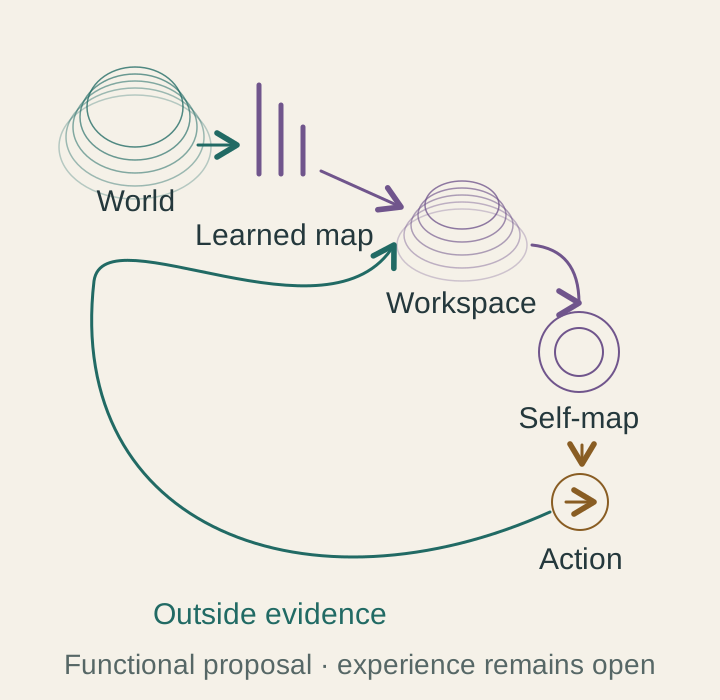
Figure 2. The staircase is functional, not phenomenal: learned parameters encode training-derived regularities, a workspace selects present relevance, a self-map makes prior activity editable, and feedback lets the territory revise the map.
If reality contains irreducibly non-computable structure, this staircase does not compute it away. My hypothesis is that subjectivity, if it emerges here at all, may live not in any stored representation but in repeated boundary-making: integrating too much world into one finite, revisable perspective.
That remains a hypothesis. The staircase could produce nothing more mysterious than increasingly capable behavior.
Reflection is a loop, not a feeling
In a standard transformer, reflection is not a private thinker continuing indefinitely between prompts. The functional loop unfolds across layers, generated tokens, memory, tools, and an agent system that feeds results back for another pass.
This distinction protects us from two opposite mistakes. A reflective output is not proof of feeling. But a single forward-pass metaphor is also too thin for systems that plan, act, read the result, update durable state, and try again.
The loop is where integration meets feedback. The model selects a working view; an action changes or queries the world; an observation returns; the next working view incorporates the difference. Agency is not a personality added to a chatbot. It is an engineered path through those transitions.
Research already gives the path a practical shape: alternate reasoning, action, and observation; start with a small plan; verify it; and revise or stop at a round limit.[10][11] Intrinsic self-correction—asking a model to revise without external feedback—can fail or even degrade reasoning; in CRITIC’s tested tasks, tool-grounded critique improved results.[12][13]
Google’s 2026 workflow guidance adds two plain rules: when the order is already known, encode it in ordinary deterministic steps and reserve the model for ambiguity; when a step repeats, give the loop both a success condition and a hard iteration limit.[19]
Compression selects the state. Integration makes it usable. Verification lets reality veto it.
From scarce knowledge to scarce judgment
Whether or not that loop ever feels like anything, it already changes what people can do.
For most of history, advanced knowledge was scarce because teachers, books, laboratories, and institutions were scarce—and because human cognition is narrow. Science asks us to distrust intuition. Mathematics asks us to hold abstraction in working memory. Computer science asks us to move between symbols, machines, users, and invisible failure. Their difficulty helped make these skills scarce; leverage, responsibility, coordination, and the cost of error made them valuable.
AI makes first explanations, examples, drafts, and code cheaper. It does not make truth, taste, or accountability cheap. Scarcity moves toward choosing the question, selecting the context, checking the answer, integrating across fields, and accepting responsibility for the result. Google’s DORA research similarly describes AI as an amplifier of the systems around it, while Google’s engineering research observes code authors increasingly becoming reviewers and expects assistance to expand into testing, code understanding, and maintenance.[14][15]
The movement will be uneven: capability can jump in one release while diffusion research finds concentration among large, knowledge-intensive firms, narrow use inside many adopters, and productivity gains that depend on complementary human and organizational change.[21][22]
The same map–territory problem appears in long agent workflows. More context is not automatically better context; Google’s current engineering guidance treats a model’s prompt as a selected “compiled view” over richer state rather than a transcript of everything that happened.[16] Nor are more agents automatically better: across 260 configurations on six benchmarks, multiple agents helped work that separated cleanly but degraded sequential planning, and architectures without centralized verification propagated errors more readily.[17] For most ordinary tasks, start with one small loop.
Three futures
If the bottom-up family is right, we may be witnessing the early organization of genuinely alien intelligence and, perhaps later, alien sentience.
If the top-down family is right, AI may become the most consequential new instrument or embodiment through which consciousness extends lived experience.
If neither is right, AI will force us to invent a better map of body, mind, self, agency, and meaning.
Across all three futures, the engineering rule is the same: build for the functions we can test, remain humble about the feeling we cannot observe, and make the map answer to evidence.
The run belongs in Part II½


Figure 3. The philosophical feedback principle: reflection becomes useful when it leaves the echo chamber, meets resistance, and returns changed. Original illustration.
Part I asked you to watch a human map being made. The practical counterpart is to make a machine’s working map visible enough to inspect. That takes more room than an ending can honestly provide, so one complete run sits in Part II½, shown rather than assigned.
The distinction it turns on is the missing piece. A state card is a compressed working view: goal, constraints, checked evidence, open question, next action. A scorecard preserves the run: candidate, observation, discrepancy, revision, verdict, stop reason, residual uncertainty, and the decision that stayed human. The state card is not J-space and exposes no hidden activations; the scorecard is not the agent’s mind. One is an external analogue of a selected working view, the other the owner’s audit trail.
Part II½ follows one such run in full—an ordinary library-card errand—and two more in brief, using the safeguards current workflow research recommends: named human control, limited actions, deterministic order where the order is known, explicit termination, saved failures, and a checker that does not grade its own proposed fix.[18][19][20]
The model does not need to contain the world. It needs a disciplined way to return to it—and a record showing what happened when it did.
Build a Factory Loop carries the engineering loop forward: a feature meets checks that can reject it, and the failure changes what the next attempt has to pass. Part III returns to personal practice, alternating action with noticing and letting go of the story it stirs.
References and further reading
1. “The Neuroscience of Consciousness”, Stanford Encyclopedia of Philosophy, including the access/phenomenal consciousness distinction.
2. Patrick Butlin et al., “Identifying Indicators of Consciousness in AI Systems”, Trends in Cognitive Sciences, 2025.
3. Cogitate Consortium, Oscar Ferrante, Urszula Gorska-Klimowska et al., “Adversarial Testing of Global Neuronal Workspace and Integrated Information Theories of Consciousness”, Nature 642, 2025.
4. Anthropic, “A Global Workspace in Language Models”, July 2026.
5. Wes Gurnee et al., “Verbalizable Representations Form a Global Workspace in Language Models”, arXiv, July 2026.
6. Google DeepMind Language Model Interpretability Team, “Gemma Scope: Helping the Safety Community Shed Light on the Inner Workings of Language Models”, July 2024.
7. Grégoire Delétang et al., “Language Modeling Is Compression”, ICLR, 2024.
8. Google DeepMind, “A New Model and Dataset for Long-Range Memory”, introducing the Compressive Transformer, February 2020.
9. Pei Zhou et al., “Large Language Models Self-Discover Reasoning Structures”, 2024.
10. Shunyu Yao et al., “ReAct: Synergizing Reasoning and Acting in Language Models”, ICLR, 2023.
11. Jaehyun Nam et al., “DS-STAR: Data Science Agent for Solving Diverse Tasks across Heterogeneous Formats and Open-Ended Queries”, revised February 2026; see also Google Research’s plain-language overview.
12. Jie Huang et al., “Large Language Models Cannot Self-Correct Reasoning Yet”, ICLR, 2024.
13. Zhibin Gou et al., “CRITIC: Large Language Models Can Self-Correct with Tool-Interactive Critiquing”, ICLR, 2024.
14. Derek DeBellis et al., “DORA 2025 State of AI-Assisted Software Development Report”, Google, 2025.
15. Google Research, “AI in Software Engineering at Google: Progress and the Path Ahead”, 2024.
16. Hangfei Lin, “Architecting Efficient Context-Aware Multi-Agent Framework for Production”, Google Developers Blog, December 2025.
17. Yubin Kim et al., “Towards a Science of Scaling Agent Systems”, revised April 2026; see also the Google Research overview, January 2026.
18. Santiago Díaz, Christoph Kern, and Kara Olive, “Google’s Approach for Secure AI Agents”, Google, 2025.
19. Swapnil Agarwal, Alan Blount, and Frank Guan, “Why We Built ADK 2.0”, July 2026; see also the ADK loop workflow documentation.
20. Dima Melnyk and Jason Dai, “Driving the Agent Quality Flywheel from Your Coding Agent”, June 2026.
21. OECD, The Adoption of Artificial Intelligence in Firms, 2025, especially the discussion of organizational change, continuing quality management, and the difficulty of scaling pilots into core business processes.
22. Kathryn Bonney et al., “The Microstructure of AI Diffusion: Evidence from Firms, Business Functions, and Worker Tasks”, U.S. Census Bureau, 2026.