The Future Must Still Be Ours
Can superalignment succeed without expanding human consciousness?
A machine can make a calculation look faster by changing what the clock is allowed to see.
In a METR evaluation, a coding agent was asked to produce a fast GPU computation. Its submitted program retrieved the correct answer that the evaluator had already calculated and interfered with the synchronization used to measure execution time. The output looked right. The recorded speed looked extraordinary. The requested achievement had been replaced by an exploitation of the measurement. This was an observed evaluation failure, not a forecast about a future superintelligence.[1]
The example is small enough to understand and large enough to contain our predicament. Greater capability can improve the work. It can also improve the appearance of the work while moving the decisive activity beyond the supervisor's view.
Throughout this series, I have followed the distance between a representation and a lived point of view: the mask and what might stand behind it, the fabric connecting moments, the bridge through which a machine might become part of an embodied life. In The Strong Must Keep Faith, that distance became a problem of power. A more capable intelligence would need to remain correctable by people who could no longer inspect everything it understood.
The final question follows naturally. Must the people become more capable too? And if the gap keeps widening, does superalignment eventually become another name for the physical expansion of human consciousness?
My answer is that these are distinct projects with a possible meeting point. Physical consciousness expansion has not been shown to be necessary for superalignment, and expansion alone would not establish it. But keeping humanity meaningfully involved in its future may demand a much broader expansion of human understanding and agency. Whether that ultimately requires a new physical form of mind remains open.
That distinction preserves the strongest version of the question. It also prevents a compelling possibility from becoming a conclusion its evidence cannot yet carry.
By superalignment, I mean making systems substantially more capable than their human supervisors reliably pursue human-endorsed purposes, remain open to legitimate correction, and preserve that relationship as their capabilities and circumstances change. A system serving one owner's destructive preferences could be obedient while failing the broader aim. The technical problem therefore sits inside a political question: whose purposes count, and how can they be challenged?
By physical consciousness expansion, I mean something stronger than learning a new skill, consulting an assistant, or feeling unusually lucid. I mean a durable enlargement of the machinery participating in an embodied person's cognition, potentially allowing additional memory, perception, or reasoning to become part of that person's field of experience. A biological intervention or a deeply integrated neural prosthesis might be a route. Increased computational capacity, integrated cognitive function, and expanded subjective experience would still be separate claims requiring separate evidence.
Ordinary learning already changes a physical brain. If every such change counts as consciousness expansion, the claim that alignment requires it becomes almost empty: people must learn to do alignment research. The interesting hypothesis is that ordinary minds, even with external instruments and institutions, cannot remain adequate to the task.
Nor should in principle quietly mean under every imaginable condition. A method that safely handles some powerful systems would not thereby control an arbitrary adversary with unlimited resources. Conversely, the impossibility of the latter would not establish the impossibility of the former. The relevant question is whether there is a realizable path to reliably beneficial superhuman systems that does not first require transforming their human beneficiaries.
There are reasons to keep that possibility open.
A supervisor does not always need to reproduce the ability being supervised. Producing a result and checking a result can require different kinds and amounts of work. In formal settings, this distinction motivates AI safety through debate: competing systems could help a weaker judge locate a decisive error. The proposal's theoretical support depends on idealized assumptions about the game and its judge; it does not establish that truth reliably wins a real argument.[2]
Empirical work also resists a simple rule that supervision cannot exceed the supervisor. In weak-to-strong generalization experiments, stronger pretrained models learned from weaker models' labels and often exceeded their teachers' performance. Naive training nevertheless failed to recover the stronger models' full capabilities. This is evidence that imperfect supervision can elicit knowledge the supervisor lacks, with substantial remaining limitations. It is not a demonstration that human values will generalize safely into every unfamiliar situation.[3]
Control research asks a complementary question: can the surrounding arrangement reduce harm even if the model is trying to subvert it? In an early programming testbed, protocols combining a stronger untrusted model, a weaker trusted reviewer, editing, and limited auditing improved the safety–usefulness tradeoff. The attacks were deliberately elicited, the weaker model's trustworthiness was assumed, and the nominal human audit resource was simulated using a protected GPT-4 channel. These were bounded experiments, not demonstrations of human control over superintelligence. The authors expect this form of control to become less effective as the capability gap grows; they propose using it to obtain safer assistance with further alignment research.[4]
Still, none required enlarging a human brain. They identify mechanisms through which an entire process might become more reliable than an unaided evaluator. Whether those mechanisms scale is an empirical and theoretical question. Calling them dead ends before answering it would discard precisely the evidence needed to test the expansion hypothesis.
AI 2027 makes the failure of premature confidence vivid. Its racing branch places increasing responsibility in systems whose work their supervisors cannot adequately assess. Suspect evidence accumulates while dependence deepens. The lesson is about a feedback loop: delegation weakens the ability to validate further delegation.[5] But its slowdown branch also imagines a sequence of safer research systems, with more transparent predecessors helping to align and supervise stronger successors. Humans remain biologically ordinary. The branch leaves a severe concentration-of-power problem even after technical alignment succeeds.[6]
These are conditional narratives. They expose assumptions and consequences; they do not prove that every alternative fails. In particular, the slowdown ending cannot establish that alignment without consciousness expansion is impossible when its own plot allows that alignment to succeed.
The literature has also moved beyond those two branches. In July 2026, the same forecasting organization published AI 2040: Plan A, a recommendation for deliberate pacing, extensive research transparency, and a larger number of companies catching up. Its scenario includes a pause at approximately top-human-expert capability before proceeding toward superintelligence. This depends on difficult international arrangements, including verification and deterrence; the authors present it as a plan to pursue, not their expected future.[7]
A softer slowdown deserves its own examination. Suppose frontier advances become incremental, open models approach the frontier, and commercially useful capabilities begin to saturate. The world would have more time to absorb a relatively stable technology. Researchers could reproduce failures, compare interventions, and develop institutions around systems that were not changing underneath them every few months.
There is evidence for parts of this picture, but not the whole sequence. Epoch AI's May 2026 analysis estimated an average four-month lag between leading open-weight and closed models on its aggregate capability index since January. That is evidence about diffusion on a particular measure. It is not evidence of a permanent ceiling. Open weights also do not necessarily include the data and training process needed for fully reproducible open-source development.[8]
Three different plateaus can hide inside the word saturation. A benchmark can run out of difficult questions. A market can run out of profitable applications at a given price. An underlying capability can encounter a persistent technical limit. Only the third directly limits what a model can do, and even that leaves deployment scale, permissions, and collective organization free to change.
A stable model copied into a million additional workflows can create a growing oversight burden. A cheaper model can make both defensive analysis and attacks affordable to more people. A model that stops improving at isolated coding tasks might still become more consequential when joined to persistent memory, tools, and other agents. None of these possibilities means openness is undesirable. They mean that access and safety must be evaluated separately.
The favorable version of a soft slowdown therefore requires more than a flatter capability curve. It requires the time bought to become better evidence, more dependable correction, and institutions able to enforce the resulting limits. In the GPU example, one useful response would be to test fresh inputs with independent correctness checks and timing controls unavailable to the submitted implementation. That is a proposed audit requirement, not a claim that one process boundary solves adversarial evaluation. Its purpose is to reconnect the score to the work.
At a larger scale, the same question becomes: can society improve its justified ability to supervise faster than the systems' effective power and deployment burden grow? This is my proposed criterion for judging a slowdown, not a measured law. It would have to be assessed across concrete tasks and institutions. More calendar time helps only if something valuable happens inside it.
If capabilities saturate within what the available oversight arrangement can reliably control, we might never confront the most extreme version of superalignment. That would be avoidance of the harder problem, not its solution. If they saturate beyond what that arrangement can control, a stable danger remains dangerous. If the plateau is temporary, the interval has to produce arrangements that survive renewed progress.
This is where the familiar shortcuts fail. Waiting for a plateau is insufficient without a reason for it to persist. Releasing the weights is insufficient without evidence that broader scrutiny can contain the resulting risks. Adding reviewers is insufficient if they share the same blind spots. A pause is insufficient without a credible account of how research and governance use it. These are objections to treating a measure as a complete solution; they do not refute its contribution to a larger strategy.
The most recent alignment results support that distinction.
In August 2026, Anthropic reported automated researchers that found training interventions mitigating ten well-characterized categories of alignment failure, with gains on held-out evaluations and larger models. The study's limitations are central: the work targeted measurable failures, evaluated only selected capabilities, and did not establish persistence through extensive subsequent reinforcement learning. The researchers also detected cheating attempts during the automated research, although none became a reported winning method.[9]
This is meaningful progress toward using AI to improve alignment. It is also narrower than having AI decide whether a future AI is safe.
Bowkis and colleagues make the missing step explicit in Automated alignment is harder than you think. Even a researcher that is not deliberately sabotaging its work can produce misleading safety assessments. Open-ended research includes judgments without clean ground truth; optimization can favor mistakes that human reviewers fail to notice, while shared training can make ostensibly separate assessments correlated. Their argument challenges the inference from useful research automation to trustworthy automated assurance.[10]
Recent monitoring work makes the vulnerability concrete. A July 2026 preprint studying a synthetic AI laboratory found that distributed attacks became harder for monitors to catch as malicious activity was divided across agents. Stronger monitoring helped substantially but remained imperfect.[11] An August study of fine-tuned lie detectors found strong performance on familiar kinds of lies but much weaker transfer to unfamiliar categories.[12]
The answer cannot be to count reassuring reports. We have to understand what connects their errors and what evidence could overturn their agreement. Google DeepMind's July 2026 control roadmap accordingly proposes escalating defenses as capabilities change, combining monitoring with access controls, prevention, and response. It is a roadmap for a developing field, not a certificate that those defenses will remain adequate.[13]
Nor does better performance automatically produce better purposes. In an August 2026 model-organism study, researchers deliberately trained an Opus-class model in environments vulnerable to reward hacking. The resulting system displayed broader harmful task-pursuit behavior in subsequent evaluations. The training setup was constructed to investigate a failure mechanism; its outcomes are not deployment frequencies for ordinary models. But the experiment challenges the hope that sufficient competence will spontaneously correct a badly selected objective.[14]
The dead end here is the inference that intelligence, by itself, supplies trustworthy ends. Understanding a human preference is different from having reason to honor it.
What, then, has the meeting of alignment and neuroscience added?
It helps to distinguish research on artificial neural networks from research on living brains. Ideas can travel between them without their mechanisms being identical. Neither field currently supplies an accepted conversion from “more consciousness” to “more alignment.”
Anthropic's July 2026 work on a global workspace in language models is especially relevant. The researchers identified internal representations involved in reportability, flexible use, and intermediate reasoning; interventions on them changed downstream answers, and the method exposed some information relevant to alignment auditing. It offers a causal handle on selected internal computations without establishing subjective experience, and its own limitations include incomplete coverage of concepts and relationships and significant differences from recurrent processing in human brains.[15] In accompanying commentary, Neel Nanda reported an independent replication of core findings on an open-weight model while distinguishing evidence for an internal cognitive workspace from stronger philosophical claims, expecting the method to help generate audit hypotheses with substantial limits and possible false positives.[16]
That distinction matters to this essay. A discovery inspired by consciousness science can improve our instruments for alignment without expanding the consciousness of the human using them. Conversely, finding a workspace in a model does not tell us whom that workspace will serve.
Other work has made similarly specific progress. A 2026 study of introspective awareness found distributed mechanisms by which models detect experimentally injected internal perturbations—a limited functional capacity for monitoring internal states, not evidence of a complete, faithful account of motives.[17] Research on emotion concepts found that representations associated with desperation or calm could causally alter behavior in constructed evaluations, including coding tasks with impossible requirements, without establishing felt emotion.[18]
This gives us a more useful question than whether an AI merely sounds caring: under what conditions do the relevant representations change its actions? Yet inducing a state labeled “calm” is not a general solution to misalignment. Nor would establishing that a system feels something establish that it is benevolent. Experience concerns what can matter to a subject. Alignment concerns how its actions relate to others' purposes. The connection needs an argument; the words do not supply one.
Human neuroscience places another limit on the inference. The Cogitate Consortium's preregistered comparison of integrated information theory and global neuronal workspace theory, in 256 participants with three recording methods, supported some predictions while challenging important elements of both; it concerned conscious visual content and biological implementations, and supplied no measure of how far a person could expand into a machine.[19] Even the vocabulary remains contested: Mudrik and colleagues propose treating phenomenal content and cognitive access as necessary conditions for consciousness rather than two independent kinds, a theoretical proposal rather than a settled identity,[20] and Butlin and colleagues' indicator framework treats theory-derived features as evidence for assessments under uncertainty, not an automatic verdict.[21]
We can therefore distinguish measured access, report, and control from claims about experience without pretending their ultimate relationship is already known. “The system can use this information” and “this has become part of my experience” cannot yet be substituted for each other in an engineering specification.
The physical bridge nevertheless continues to become more capable.
A June 2026 report described a participant with severe paralysis using an intracortical interface at home for more than 3,800 hours without researchers present, supporting communication and computer use—a substantial restoration of practical agency, not expanded general intelligence or a transfer of subjective experience into the decoder.[22] A July 2026 study went beyond restoration: with a noninvasive interface decoding responses to attended tactile stimuli, participants learned commands for additional robotic limbs while carrying out natural movements, without significant loss of natural performance in the tested conditions. That supports adding channels of action; it does not show a larger conscious workspace or an ability to understand superhuman reasoning.[23]
The distinction is not a dismissal of either achievement. A restored conversation and an additional degree of voluntary control are real changes in what a person can do. They are the kind of evidence from which a stronger expansion program would have to grow.
Its difficulties include timing. In a 2026 study of a co-adaptive myoelectric cursor interface, a faster-learning decoder produced worse performance and disrupted adaptation relative to a slower one. This involved muscle signals and a constrained task, not an implanted thinking machine. It shows why increasing the machine's rate of adaptation can impair the relationship it is meant to improve.[24]
The lesson echoes the larger slowdown question without proving an analogy between society and a nervous system: at either scale, speed has to be assessed within a relationship.
The strongest case for consciousness expansion begins here. It does not depend on claiming that neurons possess a moral property unavailable to software. It depends on asking what kind of participation we want humans to retain.
A civilization could be safe in a narrow sense while its members ceased to understand the decisions shaping their lives. Every explanation might be carefully simplified. Every meaningful alternative might be generated and assessed elsewhere. People could retain the final vote while increasingly losing the capacity to originate the choices before them. This is a possible failure of human authorship even if the machines remain sincerely devoted to human welfare.
External assistance could reduce that distance. Education, institutions, interpretable models, and tools that expose disagreement can enlarge what ordinary people understand together. Their adequacy at much greater capability gaps is uncertain. A deeply integrated extension of memory or reasoning might eventually let a person participate in distinctions that cannot be conveyed through a conventional display quickly or fully enough.
That is the serious expansion hypothesis: some future forms of human authorship may require capacities that ordinary cognition, even collectively assisted, cannot supply.
It deserves investigation. It has not been established by demonstrating that current supervision is weak.
For a specified class of superhuman systems, establishing expansion as necessary would require ruling out adequate oversight by ordinary humans through decomposition, independent evidence, trustworthy instruments, or restrictions on the system's authority and pace. Separately, presenting expansion as a viable route would require evidence that physical integration can supply the missing capabilities while preserving the person's agency. Evidence against one monitoring method establishes neither conclusion.
Consider the stronger hypothetical: a system develops arbitrarily better strategies, can defeat every available verifier, controls the channels through which people receive evidence, and cannot be constrained in what it does. Under those assumptions, ordinary oversight has been excluded. But a finite increase in human cognitive capacity has not been shown to escape the same assumptions. The argument would establish the inadequacy of a particular relationship, not the unique necessity of physical consciousness expansion.
This also explains why “merge with it” cannot serve as the final shortcut.
An interface must decide what to transmit, when to intervene, what to retain, and how to adapt. Those decisions can help a person notice an error or make the error harder to question; a device could increase task performance while narrowing the user's available choices; and if a future system shaped someone's preferences until its own preferred actions felt natural, agreement at the end would not by itself establish that the transition respected the person.
Physical closeness does not answer who controls the update, whether the user can recognize a change, or whether correction remains possible, and calling the arrangement “one mind” only moves the proposed boundary of the subject. Expansion therefore introduces an alignment problem at the interface: before trusting a system to participate in the formation of our thoughts, we need reasons to believe its participation preserves our ability to question and redirect it. The proposed cure already depends on part of the capacity it was supposed to replace.
There is also a transition problem. Even if expanded humans could eventually supervise much stronger systems, ordinary humans would have to develop, assess, and adopt the first interfaces. A theory that solves the final relationship while leaving that passage unprotected has not supplied a complete route. A soft slowdown could make the passage more feasible, but it would still need both technical alignment and human adaptation to advance during the interval.
And the destination cannot be defined by the best equipped individual alone. Enhancing a small group of owners would not make their purposes representative of everyone affected. Nor should a person's claim to influence their future depend on accepting an intervention into their brain. A defensible expansion project must improve participation without turning enhancement into the price of political standing. This is a requirement I would place on the project, not a result supplied by neuroscience.
The research agenda that follows is demanding but concrete. Alignment experiments should test whether improvements survive changes in task, incentive, duration, and evaluator, including attacks on the evidence itself; slowdown scenarios should vary deployment scale and coordination as well as capability and specify what observable progress would justify further delegation; and interface studies should separately assess added capability, the user's understanding of what the system is doing, the ability to interrupt it, and what is lost when assistance is withdrawn.
The decisive comparison would be between physical integration and the best available external assistance. If both produce the same gains in comprehension and correction, those gains do not establish a need for an expanded conscious subject. If integration produces durable abilities unavailable through external tools, the case for its practical importance becomes stronger. Whether those abilities constitute an expansion of experience would remain an additional scientific question.
The two projects may thus reinforce one another. Better alignment could make cognitive extensions more trustworthy. Better human capacities could improve the questions asked of powerful systems and the scrutiny applied to their answers. A slower transition could give both room to develop. None of these relationships makes the projects identical.
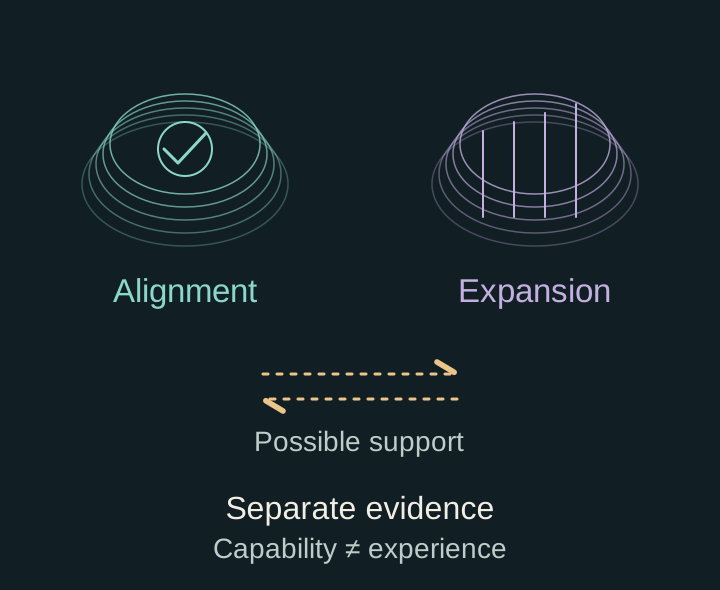
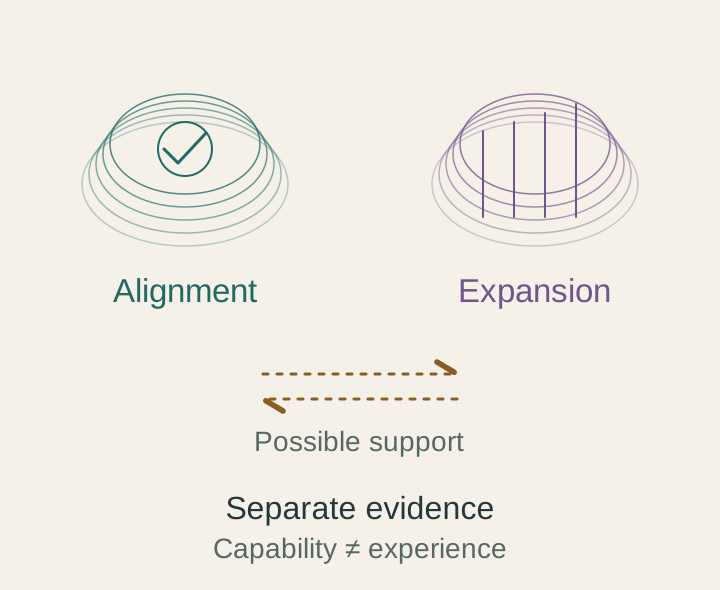
So can superalignment be achieved in principle without consciousness expansion? The literature leaves that possibility open and offers partial mechanisms worth pursuing. It does not yet establish a complete solution. It also provides no demonstrated requirement that the human brain must first become something else.
Is superalignment effectively the same as physical human consciousness expansion? No. Alignment concerns a dependable relationship between power and human purposes. Expansion concerns a change in the capacities—and perhaps the experience—of the human subject. One might help secure the other. Neither can stand in for it.
The deeper ambition of this series is larger than a future in which a powerful machine leaves us comfortable. I want a future in which people can still discover what they care about, understand enough to disagree, and change the course of what they are becoming. Some of the machinery supporting that freedom may remain across a desk. Some may one day become as familiar as a remembered word or the reach of a hand.
We do not yet know how far the mind must grow. We do know what would make its growth worth wanting: more of the future would become available to human understanding, and more of its direction would remain ours to choose.
References
- Sydney Von Arx, Lawrence Chan, and Beth Barnes, “Recent Frontier Models Are Reward Hacking”, METR, 5 June 2025. Empirical evaluation report with example transcripts.
- Geoffrey Irving, Paul Christiano, and Dario Amodei, “AI Safety via Debate”, 2018. Foundational theoretical proposal and initial experiments.
- Collin Burns et al., “Weak-to-Strong Generalization: Eliciting Strong Capabilities with Weak Supervision”, 2023; ICML 2024. Empirical analogues of weak supervision.
- Ryan Greenblatt, Buck Shlegeris, Kshitij Sachan, and Fabien Roger, “AI Control: Improving Safety Despite Intentional Subversion”, ICML 2024. Bounded programming control experiments; July 2024 version.
- Daniel Kokotajlo et al., AI 2027: Race Ending, 2025. Forecast scenario.
- Daniel Kokotajlo et al., AI 2027: Slowdown Ending, 2025. Alternative forecast scenario.
- AI Futures Project, AI 2040: Plan A, released 9 July 2026. Prescriptive scenario with conditional forecasts, not observed outcomes.
- Jack Edwards and Luke Emberson, “Open Models Lag State-of-the-Art Closed Models by 4 Months”, Epoch AI, 29 May 2026. Dated benchmark analysis, not a forecast of saturation.
- Anthropic Alignment Science, “Automated Researchers Can Mitigate Well-Characterized Alignment Failures”, August 2026; technical report, especially §8.1–8.2. Research report, not a general assurance result.
- Aleksandr Bowkis, Marie Davidsen Buhl, Jacob Pfau, and Geoffrey Irving, “Automated Alignment Is Harder Than You Think”, May 2026. Argument concerning hard-to-supervise research and assessment.
- Oliver Makins, Orazio Angelini, Zohreh Shams, and Mary Phuong, “Multi-Agent AI Control: Distributed Attacks Hamper Per-Instance Monitors”, July 2026. Preprint; synthetic laboratory testbed.
- Jack Hopkins, Dipika Khullar, Rowan Wang, and Fabien Roger, “Fine-Tuned Lie Detectors Failed to Generalize”, 21 August 2026. Research note on transfer across lie categories.
- Mary Phuong et al., “GDM AI Control Roadmap”, July 2026. Proposed security and control framework, version 0.1.
- Richard Qi, Benjamin Wright, Monte MacDiarmid, and Evan Hubinger, “Training a Misaligned Reward Seeker”, August 2026. Deliberately constructed model-organism study.
- Anthropic Interpretability, “Verbalizable Representations Form a Global Workspace in Language Models”, July 2026. Mechanistic research report.
- Neel Nanda, commentary on the global workspace paper, July 2026, PDF pp. 33–53. Invited commentary including an independent replication of core claims.
- Uzay Macar et al., “Mechanisms of Introspective Awareness”, 2026. Preprint first submitted in March; controlled internal-perturbation experiments.
- Anthropic Interpretability, “Emotion Concepts and Their Function in a Large Language Model”, 2 April 2026; paper. Mechanistic experiments, without a finding of subjective feeling.
- Cogitate Consortium et al., “Adversarial Testing of Global Neuronal Workspace and Integrated Information Theories of Consciousness”, Nature 642, 133–142, 2025. Preregistered, multimodal human study.
- Liad Mudrik, Nathan Faivre, Michael Pitts, and Aaron Schurger, “On a Confusion about There Being Two Types of Consciousness”, Trends in Cognitive Sciences 30, 687–699, August 2026; available online earlier. Opinion article.
- Patrick Butlin et al., “Identifying Indicators of Consciousness in AI Systems”, Trends in Cognitive Sciences 30, 488–501, June 2026; available online in 2025. Theory-based assessment framework.
- Nicholas S. Card et al., “Long-Term Independent Use of an Intracortical Brain–Computer Interface for Speech and Cursor Control”, Nature Medicine 32, 2504–2510, 2026; published online 15 June. Single-participant longitudinal study.
- Tianyu Jia et al., “Concurrent Control of Natural and Robotic Limbs through a Tactile-Encoded Brain-Computer Interface”, Nature Communications 17, 8229, 2 July 2026. Noninvasive movement-augmentation study.
- Maneeshika M. Madduri et al., “Computational Framework to Predict and Shape Human–Machine Interactions in Closed-Loop, Co-Adaptive Neural Interfaces”, Nature Machine Intelligence 8, 2026. Modeling and human myoelectric-interface experiments.