The Art of Steering Horses and AI
Watch a horse and rider moving well together. What becomes visible is a rhythm that belongs to the pair. The rider moves with the horse, the horse responds to the rider, and each adjustment becomes part of the conditions for the next. Direction takes shape through their movement.
I think this is where the interesting comparison with AI begins.
It is natural to describe the interaction in separate pieces: a person has an intention, a model produces a response, and the person decides what to do with it. That account captures the exchanges. To understand what can develop through them, we have to follow the movement across the whole relationship.
A response changes what I can see. What I now see changes what I ask. The next response enters a situation that our earlier exchange has already transformed. After several turns, the thought we are developing may have become something neither the initial request nor the first answer contained.
I want to call this symbiotic movement: a developing capacity to perceive, think, and act together, in which each contribution opens possibilities for the next.
The horse makes this idea tangible because coordination has a physical form. In a small study comparing an expert and a novice riding the same horse at a trot, researchers found that the expert stayed more closely synchronized with the horse's movement. The horse's movement was also more temporally regular with the expert. Skill appeared in the organization of the pair. Coordination Dynamics of the Horse–Rider System
What interests me about that result is where it asks us to look. We can examine the rider and the horse separately, but the quality of their movement also belongs to the relationship between them. A rider's capacity to influence the motion develops through a capacity to participate in it.
Steering happens from within the movement.
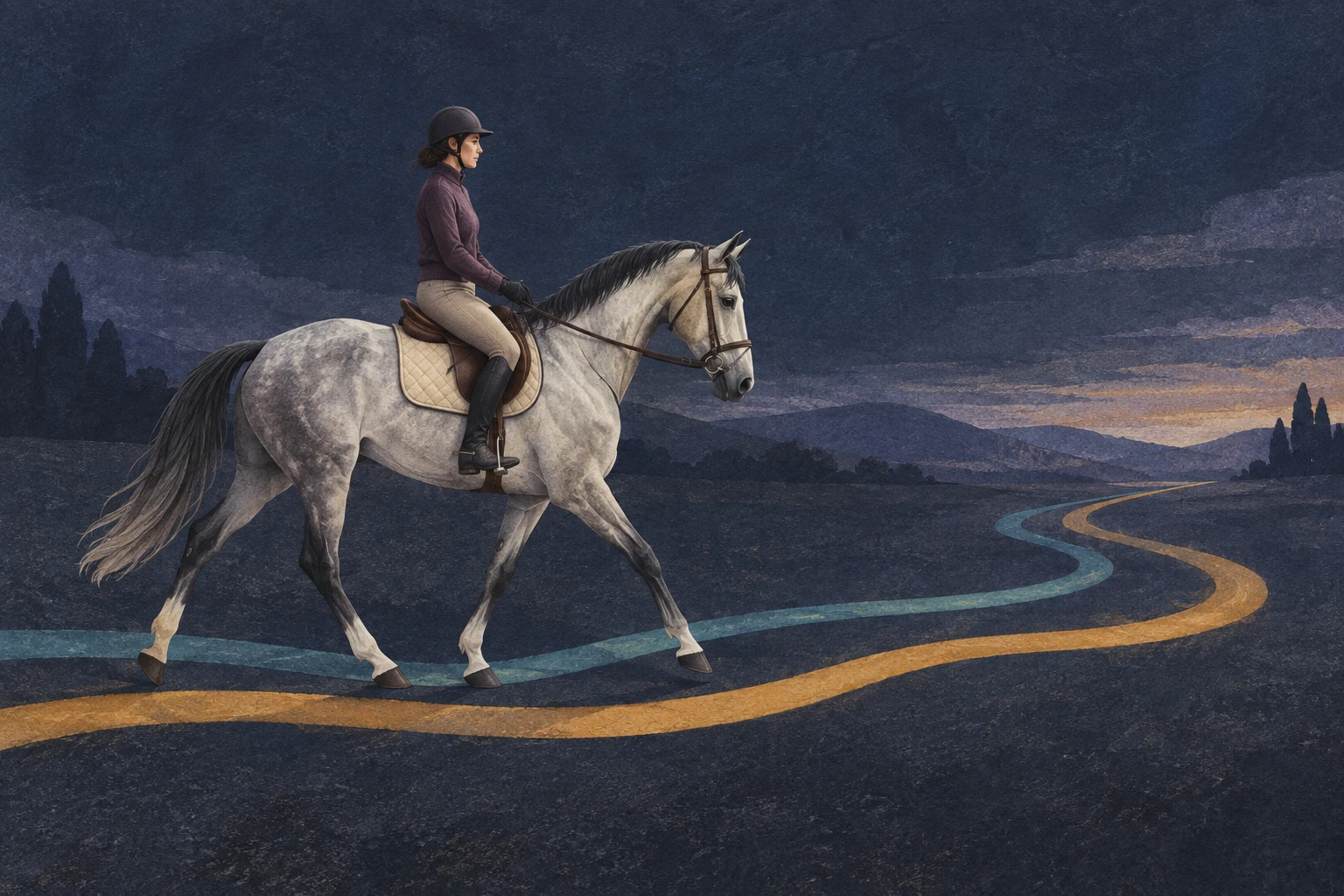
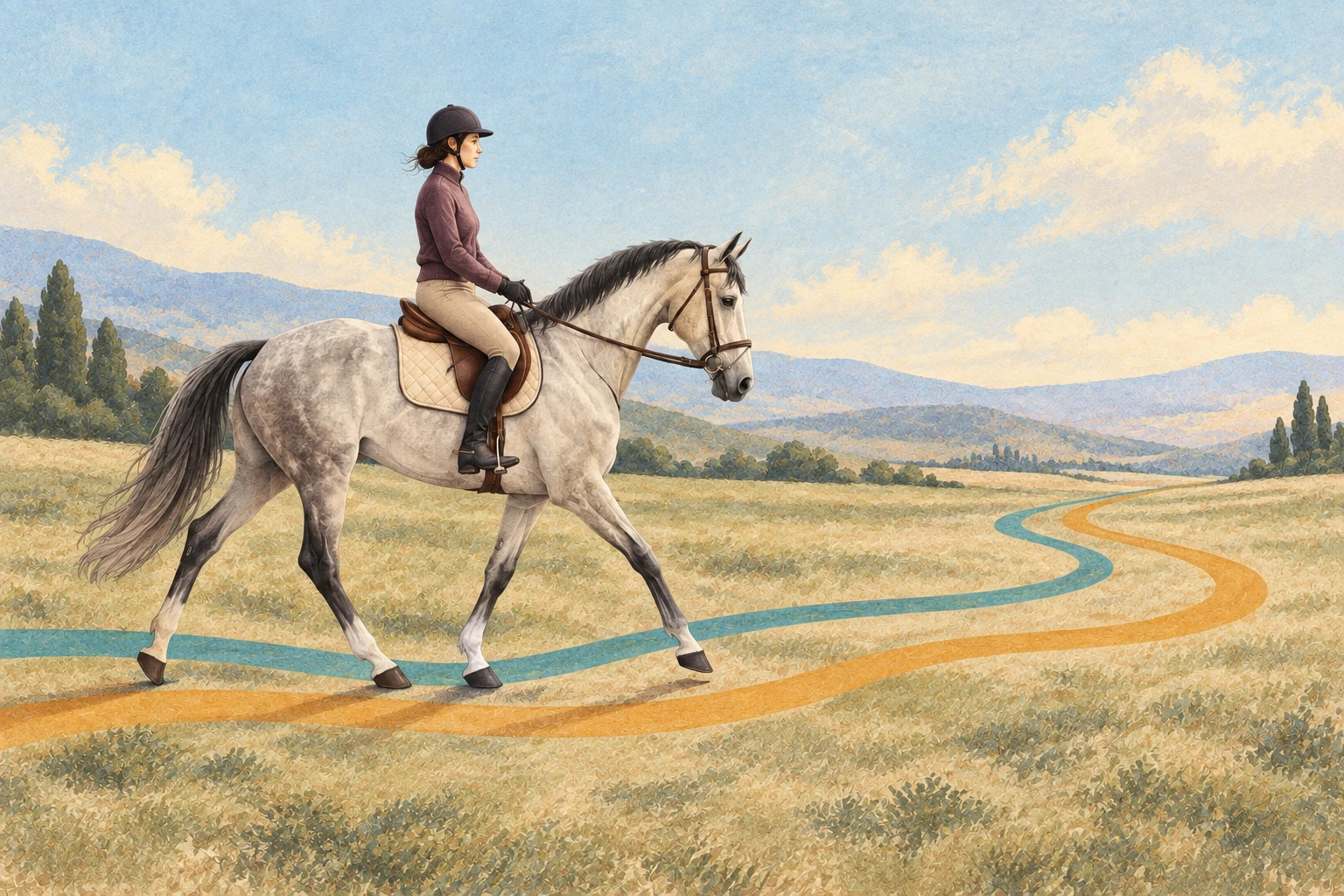
With AI, much of that movement passes through language. An unfinished thought becomes a sentence, a diagram, a question, or a piece of code. The model develops it into something we can encounter. We recognize a possibility, notice a distinction, or discover that the direction is different from what we had in mind. That recognition becomes the next contribution.
There is a subtlety here: sometimes the response lets us say more clearly what we already meant. The first formulation gave the thought somewhere to begin. Its meaning becomes more precise as it moves.
This possibility has a long history in computing. In his 1960 essay Man–Computer Symbiosis, J. C. R. Licklider imagined computers participating in the formation of problems. He described an interaction in which trying an approach could expose a flaw or reveal an unexpected direction, helping the person formulate what to investigate next. Man–Computer Symbiosis
Language models give that idea a particularly immediate form. We can begin with an intuition whose vocabulary is still incomplete and work out its structure in the exchange. The ability to continue from something unfinished changes the kinds of thinking we can attempt.
Musical improvisation makes the same possibility audible. IRCAM's Somax2 draws on a learned collection of musical material while responding to a live musician. What the musician plays influences which possibilities the system draws from that collection. Its response then becomes something the musician can hear and continue from. IRCAM on human–machine co-creativity
The musical direction can develop through that exchange. A phrase invites a response; the response changes how the phrase can continue. Each participant brings a repertoire, while the performance acquires its particular form through their encounter. This is the sense of symbiosis I want to carry into our everyday work with AI.
Consider an illustrative example. A writer begins an essay with the idea that memory is what we preserve. An AI develops that thought through images of archives, photographs, and stored conversations. Reading the result, the writer notices that something essential is missing: an archive can remain untouched. The memory they are trying to understand is the kind that changes what happens now.
That distinction becomes the next instruction. The model explores how a remembered promise enters a decision, how a familiar place changes attention, how an old mistake shapes a new attempt. The writer recognizes a connection among those cases and gives it a name: continuity through action.
Now the essay has a direction that emerged through the exchange. The initial idea made the first response possible. The response gave the writer something against which to discover a distinction. That distinction changed what the model could develop. Each contribution altered the possibilities available to the other.
For me, the interesting unit is the developing thought. A phrase can disappear from the final essay and still have made an essential contribution by helping the writer see what comes next. Influence travels through the changes it makes possible.
This also changes how I think about intention.
One familiar picture has intention arriving fully formed, waiting for the right instrument to express it. Yet creative work gives us many cases in which making something is part of discovering what we intend. A sketch changes the building. A sentence changes the argument. A working prototype changes the question the product is trying to answer.
There can be a real direction before there is a complete destination. We may know what draws our attention, which possibility deserves pursuit, or which quality we want the work to acquire. The details become available through engagement. Steering holds that developing direction while allowing the encounter to give it form.
This is why the ability to receive a contribution matters as much as the ability to initiate one. A response earns its place in our thinking when it moves the work. We need enough openness to follow an unexpected connection and enough presence to notice whether it carries the work somewhere meaningful.
The art includes timing. In a conversation, I can interrupt an idea before it has become clear enough to understand, or let an elaborate development travel far beyond the point where a small correction would have changed its course. I can ask for alternatives while a useful line of thought is still unfolding. I can keep refining a question that is already ready to meet an example.
These are judgments about the movement of the work. The next useful contribution may be a paragraph, a pause, a drawing, an objection, or an attempt to make the idea function. Learning to recognize which one belongs here is part of becoming skilled in the relationship.
The horse and rider give us an image for that sensitivity: participation acquires rhythm. With AI, I would look for a corresponding fluency in how we develop a thought, change direction, and carry a discovery into the next action.
Difference is essential to this process. An unexpected contribution gives the interaction somewhere to go. We can disagree with an answer and still use the encounter to discover a more precise question. We can follow a suggestion and arrive somewhere we would not have chosen from the starting point.
Symbiotic movement becomes interesting when that difference remains productive. The participants retain distinct contributions while becoming more capable of making those contributions matter to each other. Agreement is one possible moment in that movement. So are surprise, resistance, and revision.
Over time, the relationship can acquire a history. Recurring distinctions become easier to express. Examples carry meanings that previously required long explanations. A project holds decisions, experiments, and partially developed ideas that can be brought back into the work. We gain a richer place from which to continue.
This history also changes the person. A question that once felt impossible to formulate becomes approachable. An unfamiliar field acquires enough structure to explore. The person begins to anticipate possibilities earlier, and to steer toward them before they are fully developed.
That is an especially interesting form of amplification: an expansion in what we can participate in. We can enter a more complex inquiry, remain with it longer, and shape it as it grows. The relationship becomes part of how a capacity develops.
In this series, I have been interested in how a self takes shape through memory, attention, reflection, and its relationships with the world. Symbiotic movement brings that question into ordinary activity. As we think and build with AI, we are also practicing ways of attending, expressing intention, encountering difference, and continuing from what we discover.
I think the horse is a powerful image for this because the relationship is visible in the motion. We see coordination becoming a way of moving through the world. With AI, we can look for that same development in the course of a conversation, the formation of an idea, and the work that follows.
The art of steering asks us to become sensitive to what the interaction is making possible, and skilled enough to take part in its unfolding. We learn to steer by becoming part of the movement we are trying to create.